. Military Space News .
First Neptune Trojan Discovered

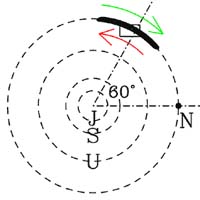
A bird's-eye view of the outer solar system shows the orbits of Jupiter (J), Saturn (S), Uranus (U), and Neptune (N) about the Sun shown schematically. The dark tube of points lying on Neptune's orbit marks the path of the newly discovered Trojan object 2001 QR322, relative to Neptune. The Trojan shuttles back and forth along Neptune's orbit as indicated by the red and green curved arrows. Each full shuttling takes about 10,000 years to complete. Chart by Deep Ecliptic Survey Team/NOAO/AURA/NSF

Tucson - Jan 09, 2003
Astronomers have discovered a small body orbiting the Sun at the distance of Neptune whose orbit makes it the first known member of a long-sought population of objects known as Neptune Trojans.

This small body, known as 2001 QR322, leads Neptune around its orbit in such a way as to maintain -- on average -- approximately equal distance from Neptune and the Sun. As such, it mimics the Trojan asteroids of Jupiter, which orbit the Sun in two clouds approximately 60 degrees ahead of and behind Jupiter. The first Jovian Trojan was discovered in 1906, and approximately 1,560 such objects are known today. However, until the discovery of 2001 QR322, Trojan-like objects associated with other giant planets had not been found.

2001 QR322 was discovered in the course of the Deep Ecliptic Survey, a NASA-funded survey of the outer solar system that uses the National Science Foundation's telescopes at Kitt Peak National Observatory near Tucson, AZ, and Cerro Tololo Inter-American Observatory in Chile.

Astronomers from Lowell Observatory, the Massachusetts Institute of Technology, the University of California at Berkeley, the University of Hawaii, the University of Pennsylvania, and the Large Binocular Telescope Observatory comprise the Deep Ecliptic Survey team.

The team first detected 2001 QR322 on August 21, 2001, in deep digital images taken with the 4-meter Blanco Telescope at Cerro Tololo by Marc Buie, Robert Millis, and Lawrence Wasserman of Lowell Observatory. However, several subsequent observations, made with a variety of telescopes over the past 16 months, coupled with numerical orbit integrations of the trajectory of the asteroid, were required to prove that 2001 QR322 is indeed a Neptune Trojan. The object is estimated to be approximately 230 kilometers (140 miles) in diameter and, like Neptune, requires about 166 years to complete each circuit of its orbit.

"Neptunian Trojans were long suspected to exist and it is gratifying to finally know that they do," says team member Eugene Chiang of the University of California at Berkeley. "The orbit of 2001 QR322 is remarkably stable; projections of its trajectory into the future reveal that it can co-orbit with Neptune for at least billions of years. "It is likely that 2001 QR322 is a dynamically pristine object whose orbital eccentricity and inclination have been largely unaltered by processes that afflicted the majority of bodies in the outer solar system," said Chiang.
Related Links
Deep Ecliptic Survey
National Optical Astronomy Observatory
Lowell Observatory
SpaceDaily
Search SpaceDaily
Subscribe To SpaceDaily Express

Student Science Instrument Selected for Ride to Pluto
Boulder - Jan 6, 2003
It's a 20-year homework assignment, but you won't hear any complaints from the students handed the task. A special instrument, called the Student Dust Counter, has been added to NASA's New Horizons mission to Pluto and the Kuiper Belt.


  • US Warned Not To Ignore Chinese Military Advances

  • Pakistan, India In Tit-For-Tat Missile Tests
  • Successful Launch of Minuteman III ICBM Do Art On A Mass Scale
  • Kashmiris Vote As Indian And Pakistani Guns Boom
  • India, Pakistan Back to Sparring over Kashmir

  • Missile Shield Will Start From Pacific Testbed
  • Northrop Grumman Conducts Supersonic Test Of Miniature Interceptor
  • Boeing Kinetic Warhead Technology Key to Successful Aegis Tests
  • Northrop Grumman Tests Peripheral Vertical Launching System

  • Lockheed Martin To Study Big Target Rocket Concepts
  • Missiles In "Position" As India Mulls Further Action Against Pakistan
  • Abm Pullout: The Phonecall That Soured Putin's Year. Or Did It?
  • US Official Defends Plans for Missile Defense Despite Test Failure

  • Aurora Builds Low-speed Wind Tunnel
  • Yeager To Retire From Military Flying After October Airshow
  • Yeager To Retire From Military Flying After October Airshow
  • Boeing Signs Technology Development Agreement With JAI For Work On Sonic Cruiser

  • Pioneer UAV Gets Video Data Connection To Navy Harrier
  • Iraq Shoots Down US Recon Robot
  • Trans-Atlantic Cooperation Continues With Global Hawk UAV Project
  • Four Northrop Grumman Unmanned Systems Achieve Autonomous Flight Milestones


  • The content herein, unless otherwise known to be public domain, are Copyright 1995-2006 - SpaceDaily.AFP and UPI Wire Stories are copyright Agence France-Presse and United Press International. ESA PortalReports are copyright European Space Agency. All NASA sourced material is public domain. Additionalcopyrights may apply in whole or part to other bona fide parties. Advertising does not imply endorsement,agreement or approval of any opinions, statements or information provided by SpaceDaily on any Web page published or hosted by SpaceDaily. Privacy Statement