|
 |
 |
 |
 |
 |
 |
 |
 |
 |

| . |  |
. |
First Observation Of A Uranian Mutual Event
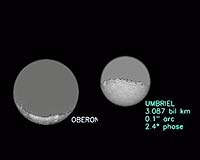
Armagh, UK (SPX) May 18, 2007 An international team of astronomers led by Apostolos Christou at Armagh Observatory has made the first ever observation of one of the satellites of the planet Uranus passing in front of another. The observation was made on the night of 4th May by Marton Hidas and Tim Brown, of the Las Cumbres Observatory Global Telescope, Santa Barbara, California, using the robotic Faulkes Telescope South at Siding Spring Observatory, Australia. This work involves a collaboration between scientists at Siding Spring, Las Cumbres, Armagh and Cardiff University. When one satellite passes in front of another, the phenomenon is known as an occultation; when one moves into the shadow of another it is an eclipse. Collectively, occultations and eclipses are called mutual events. These provide a means to determine the positions of the satellites with exceptional precision, better than any optical telescope, but they are rare. In the case of Uranus, a season of mutual events occurs just once every 42 years, each individual event lasting just a few minutes. At the time of the last Uranian mutual event season, Man had yet to walk on the Moon. Not surprisingly, no-one had successfully recorded any mutual event involving these extremely faint satellites, which are 3,000 million kilometres from Earth. But this situation changed this month, when the Faulkes telescope observed the satellite Oberon (named after the "King of Shadows and Fairies" in Shakespeare's "A Midsummer Night's Dream") occulting Umbriel (the "dusky melancholy sprite" in Alexander Pope's poem "The Rape of the Lock"). As Oberon's disc encroached upon Umbriel's, gradually blocking off Umbriel's light, the combined brightness of the moons dropped by about a third. Measurements of such changes in brightness, and comparison with models of the satellites' motions, allow astronomers to work out the masses of the moons and the effects of the shape of Uranus on their orbits, and to model their surface features. The current Uranian mutual-event season is expected to lead to some of the greatest advances in the study of the Uranian system since the flyby of the Voyager 2 spacecraft in 1986. This observation kicks off a campaign extending from now into 2008 to observe the entire mutual event season. It highlights the value of the North and South Faulkes telescopes for recording rare, time-critical events. And because the telescopes have an educational focus, the data will eventually be used not just by astronomers but also by schools and schoolchildren worldwide. Email This Article
Related Links  Cameron Park (SPX) May 18, 2007
One of the first pieces I wrote for SpaceDaily, over seven years ago, was on the already increasingly goofy debate over whether not to continue calling Pluto a "planet". Well, the debate has now proceeded to an official vote by the IAU that gained worldwide headlines by changing Pluto's title -- and it remains as goofy as ever. |
|
|

| The content herein, unless otherwise known to be public domain, are Copyright 1995-2006 - SpaceDaily.AFP and UPI Wire Stories are copyright Agence France-Presse and United Press International. ESA PortalReports are copyright European Space Agency. All NASA sourced material is public domain. Additionalcopyrights may apply in whole or part to other bona fide parties. Advertising does not imply endorsement,agreement or approval of any opinions, statements or information provided by SpaceDaily on any Web page published or hosted by SpaceDaily. Privacy Statement |