
 |
 |
 |
 |
 |
 |
 |
 |
 |
 |

| . |  |
. |

Washington (AFP) Nov 18, 2010 A hot, gaseous and fast-spinning planet has been found orbiting a dying star on the edge of the Milky Way, in the first such discovery of a planet from outside our galaxy, scientists said Thursday. Slightly larger than the size of Jupiter, the largest in our solar system, the newly discovered exoplanet is orbiting a star 2,000 light years from Earth that has found its way into the Milky Way. The pair are believed to be part of the Helmi stream, a group of stars that remains after its mini-galaxy was devoured by the Milky Way some six to nine billion years ago, said the study in Science Express. "This discovery is very exciting," said Rainer Klement of the Max Planck Institute for Astronomy. "Because of the great distances involved, there are no confirmed detections of planets in other galaxies. But this cosmic merger has brought an extragalactic planet within our reach." Astronomers were able to locate the planet, coined HIP 13044 b, by focusing on the "tiny telltale wobbles of the star caused by the gravitational tug of an orbiting companion," the study said. They used a powerful telescope owned by the European Southern Laboratory at La Silla Observatory in Chile, located at an altitude of 2,400 meters (7,800 feet) some 600 kilometers (375 miles) north of the capital, Santiago. The planet is quite close to the star it is orbiting, and survived a phase in which its host star went through a massive growth after it depleted its core hydrogen fuel supply, a phase known as the "red giant" stage of stellar evolution. "This discovery is particularly intriguing when we consider the distant future of our own planetary system, as the Sun is also expected to become a red giant in about five billion years," said lead researcher Johny Setiawan of the Max Planck Institute for Astronomy. The exoplanet is likely to be quite hot because it is orbiting so close to its star, completing each orbit in just over 16 days, and is probably near the end of its life, astronomers said. The star may have already swallowed other planets in its orbit, making the star spin more quickly and meaning that time is running out for the surviving exoplanet. Astronomers were mystified as to how the planet might have formed, since the star contained few elements heavier than hydrogen and helium and planets typically form out of a complex cloud of spinning space rubble. "It is a puzzle for the widely accepted model of planet formation to explain how such a star, which contains hardly any heavy elements at all, could have formed a planet," said Setiawan. "Planets around stars like this must probably form in a different way."
Share This Article With Planet Earth
Related Links Lands Beyond Beyond - extra solar planets - news and science Life Beyond Earth

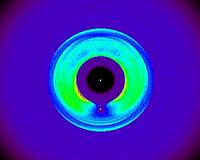 Eartly Dust Tails Point To Alien Worlds
Huntsville AL (SPX) Nov 15, 2010 Did you know that the Earth has a dust tail? The Spitzer Space Telescope sailed right through it a few months ago, giving researchers a clear idea of what it looks like. That could be a big help to planet hunters trying to track down alien worlds. "Planets in distant solar systems probably have similar dust tails," says Spitzer project scientist Mike Werner. "And in some circumstances these dus ... read more |
|
|
| The content herein, unless otherwise known to be public domain, are Copyright 1995-2010 - SpaceDaily. AFP and UPI Wire Stories are copyright Agence France-Presse and United Press International. ESA Portal Reports are copyright European Space Agency. All NASA sourced material is public domain. Additional copyrights may apply in whole or part to other bona fide parties. Advertising does not imply endorsement,agreement or approval of any opinions, statements or information provided by SpaceDaily on any Web page published or hosted by SpaceDaily. Privacy Statement |


 del.icio.us
 Digg
Digg Reddit
 YahooMyWeb
 Google
 Facebook


