
 |
 |
 |
 |
 |
 |
 |
 |
 |
 |

| . |  |
. |

Paris (AFP) Aug 25, 2010 The first "supermassive" black holes were created relatively soon after the Big Bang that created the Universe, a finding which could rewrite theories about the formation of galaxies, scientists said on Wednesday. Ordinary black holes are entities of mass whose gravitational pull is so huge that not even light can escape them. But they are dwarfs compared to so-called supermassive black holes, which are many orders of magnitude bigger. Since the first of these behemoths was spotted 12 years ago, astronomers have come to the conclusion that every galaxy, including the Milky Way, has a supermassive black hole at its core, some of them with a mass billions of times that of our Sun. Supermassive black holes seem like a phenomenon straight out of sci-fi, for they gobble up stars and planets that edge close to their gravitational maw. But this act may not be purely destructive. By drawing in and churning up interstellar gas, the black hole could also be a creative force, helping to generate new stars and solar systems, say astrophysicists. In a study published in Nature, scientists co-led by Lucio Mayer, a professor of theoretical physics at the University of Zurich, say the first supermassive black holes were created about a billion years after the blast that gave birth to the Universe some 14 billion years ago. Their simulation, created by super computers, sees huge proto-galaxies that collide, merging into a packed, dense cloud of gas that then undergoes gravitational collapse and eventually forms a massive black hole. The paper challenges the standard theory whereby galaxies grow incrementally: that gravity pulls small masses together and this goes on to form larger structures step by step. "Our result shows that big structures -- both galaxies and massive black holes -- build up quickly in the history of the Universe," said co-author Stelios Kazantzidis of Ohio State University. If so, the implications for cosmology could be far-reaching. "For example, the standard idea, that a galaxy's properties and the mass of its central black hole grow in parallel, will have to be revised," Kazantzidis said. "In our model, the black hole grows much faster than the galaxy. So it could be that the black hole is not regulated at all by the growth of the galaxy. It could be that the galaxy is regulated by the growth of the black hole." The computer simulation is based on recent findings that the first galaxies emerged sooner after the Big Bang than thought, and comprised stars that were much more massive than present-day stars -- up to 300 times the mass of our Sun. It also factors in the belief that the merged galaxy would be far smaller, and denser, than in previous simulations. In the new scenario, gas and dust in the centre of the merged galaxy condensed to form a tight disk. The disk became unstable and the gas and dust contracted again, forming an even denser cloud that in the end spawed a supermassive black hole.
Share This Article With Planet Earth
Related Links Understanding Time and Space

 How Much Mass Makes A Black Hole
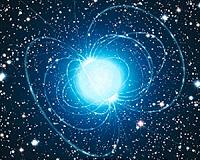
Paris, France (SPX) Aug 19, 2010 Using ESO's Very Large Telescope, European astronomers have for the first time demonstrated that a magnetar - an unusual type of neutron star - was formed from a star with at least 40 times as much mass as the Sun. The result presents great challenges to current theories of how stars evolve, as a star as massive as this was expected to become a black hole, not a magnetar. This now raises a ... read more |
|
|
| The content herein, unless otherwise known to be public domain, are Copyright 1995-2010 - SpaceDaily. AFP and UPI Wire Stories are copyright Agence France-Presse and United Press International. ESA Portal Reports are copyright European Space Agency. All NASA sourced material is public domain. Additional copyrights may apply in whole or part to other bona fide parties. Advertising does not imply endorsement,agreement or approval of any opinions, statements or information provided by SpaceDaily on any Web page published or hosted by SpaceDaily. Privacy Statement |


 del.icio.us
 Digg
Digg Reddit
 YahooMyWeb
 Google
 Facebook


