Subscribe free to our newsletters via your
. Military Space News .


MARSDAILY
Fostering Curiosity: Mars Express relays rocky images
by Staff Writers
Paris (ESA) Nov 27, 2012


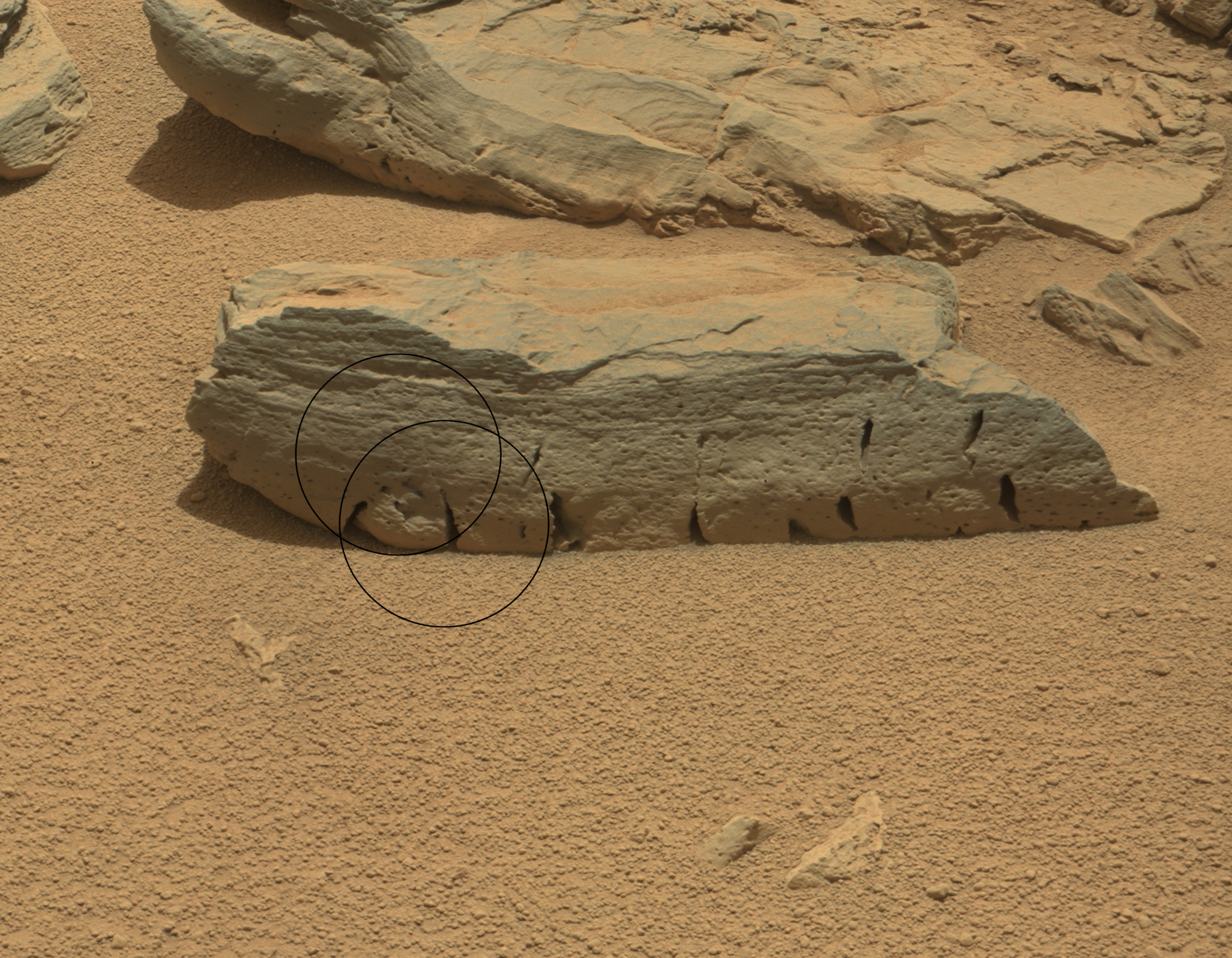
The Mastcam 100 colour image shows Rocknest3 targeted by ChemCam and later by APXS; the fields of view of the RMI images are indicated. Rocknest3 is approximately 10 x 40 cm or roughly the size of a shoebox. Credits: NASA/JPL-Caltech/Malin Space Science Systems. For a larger version of this image please go here.

For the first time, ESA's Mars orbiter has relayed scientific data from NASA's Curiosity rover on the Red Planet's surface. The data included detailed images of 'Rocknest3' and were received by ESA's deep-space antenna in Australia. It was a small but significant step in interplanetary cooperation between space agencies.

Early on the morning of 6 October, ESA's Mars Express looked down as it orbited the planet, lining up its lander communication antenna to point at Curiosity far below on the surface.

For 15 minutes, the NASA rover transmitted scientific data up to the ESA satellite. A few hours later, Mars Express slewed to point its high-gain antenna toward Earth and began downlinking the precious information to the European Space Operations Centre in Darmstadt, Germany, via the Agency's 35 m-diameter antenna in New Norcia, Australia.

The data were immediately made available to NASA's Jet Propulsion Laboratory in California for processing and analysis, proving again that NASA's amazing new rover can talk with Europe's veteran Mars orbiter.

Curiosity's ChemCam images Rocknest3
The information included a pair of tremendously interesting images acquired on 4 October by Curiosity's ChemCam Remote Micro-Imager camera.

ChemCam comprises the camera together with a Laser-Induced Breakdown Spectrometer, which fires a laser at targets and analyses the chemical composition of the vaporised material.

The laser zaps areas smaller than 1 mm across on the surface of martian rocks and soils, and then the spectrometer provides information on the minerals and microstructures in the rocks.

Outstanding image quality
The first image (at top of article) was taken before a series of five ChemCam laser blasts and the second image (at right) was taken after. The image is centred on the fifth observation point.

"The quality of these images from ChemCam is outstanding, and the mosaic image of the spectrometer analyses has been essential for scientific interpretation of the data," says Sylvestre Maurice, Deputy Principal Investigator for ChemCam at France's Research Institute in Astrophysics and Planetology (IRAP).

"This combination of imaging and analysis has demonstrated its potential for future missions."

ChemCam laser targets
A third image, relayed separately by NASA, indicates the locations of the laser target points on Rocknest3, as seen by the RMI camera.

'Rocknest' is the area where Curiosity stopped for a month to perform its first mobile laboratory analyses on soil scooped from a small sand dune. Rocknest3 was a convenient nearby target where ChemCam made more than 30 observations using 1500 laser shots.

A wide-angle context image was acquired by Curiosity's MastCam and shows Rocknest3 as targeted by ChemCam. Rocknest3 is about 10 x 40 cm, or roughly the size of a shoe box.

Fostering Curiosity - and others
ESA's Mars orbiter has also relayed data for NASA's other surface missions - Phoenix, Spirit and Opportunity - since 2004, and it relayed Curiosity's radio signal during its arrival at Mars last August.

During the Curiosity mission, Mars Express is set to provide additional relay slots, while maintaining its own scientific observation programme, under an ESA-NASA support agreement.

It can also rapidly provide relay services in case of unavailability of NASA's own relay orbiter or if there is a problem on the rover itself.

Interplanetary cooperation
"ESA-NASA cooperation at Mars is a continuing success, and comes after both sides have worked diligently for a number of years to set technical and engineering standards to enable sharing data between spacecraft, networks and ground stations," says Mars Express Spacecraft Operations Manager Michel Denis.

"Exploring Mars is a huge challenge, and space agencies are working to boost cooperation and mutual support for current and upcoming missions. It's the way of the future."

.


Related Links
Mars Express
Mars Science Laboratory
Mars News and Information at MarsDaily.com
Lunar Dreams and more


Comment on this article via your Facebook, Yahoo, AOL, Hotmail login.

Share this article via these popular social media networks
del.icio.usdel.icio.us DiggDigg RedditReddit GoogleGoogle


MARSDAILY
One Year After Launch, Curiosity Rover Busy on Mars
Pasadena CA (JPL) Nov 27, 2012
The NASA Mars rover Curiosity began its flight to Mars on Nov. 26, 2011, from Cape Canaveral Air Force Station, Fla., tucked inside the Mars Science Laboratory spacecraft. One year after launch and 16 weeks since its dramatic landing on target inside Gale Crater, Curiosity has returned more than 23,000 raw images, driven 1,696 feet (517 meters) and begun helping researchers better understa ... read more


MARSDAILY
Israel tests new weapon, but gap remains

Israel reports success in new missile defence test

NGC Completes Air and Missile Defense Radar Technology Demonstration

Russia warns Turkey against deploying Patriot missiles

MARSDAILY
Hamas arsenal hit but rocket know-how intact

Turkey insists Patriots would be 'purely defensive'

India tests missile interceptor

South Korea deploys new cruise missiles: report

MARSDAILY
Rise of the Machines: Combat Drones to look for in the near future

Precision, Wireless Ground Handling of X-47B Unmanned Aircraft

Lockheed Martin Acquires Chandler May

USAF and Raytheon evaluate avoidance capabilities for safe UAS flight

MARSDAILY
Lockheed Martin to Demonstrate Key Component of Tactical MilSat Communications System

The Skynet 5D secure telecom satellite is received in French Guiana for Arianespace's December Ariane 5 mission

Lockheed Martin Completes On Orbit Testing of Second AEHF Satellite

LynuxWorks LynxOS-SE Deployed by ITT Exelis in New Line of Software-Defined Radios

MARSDAILY
Russia frees physicist convicted of spying for China

Dog noses inspire explosives detector

10 killed in Yemen military plane crash: ministry

Britain defends shooting pigs for army medic training

MARSDAILY
Japan's opposition pledges national security boost

Defense contest over major gulf arms buys

China eyes S. America as defense customer

Marine general sworn in at US Southern Command

MARSDAILY
Passport squabble irks Chinese travelers

India counters China map claims in a tit-for-tat move

Japan appoints new ambassador to China

US-Myanmar detente forces Chinese rethink: experts

MARSDAILY
Penn Researchers Make Flexible, Low-voltage Circuits Using Nanocrystals

King's College London finds rainbows on nanoscale

Optical microscopes lend a hand to graphene research

Controlling heat flow through a nanostructure


The content herein, unless otherwise known to be public domain, are Copyright 1995-2014 - Space Media Network. AFP, UPI and IANS news wire stories are copyright Agence France-Presse, United Press International and Indo-Asia News Service. ESA Portal Reports are copyright European Space Agency. All NASA sourced material is public domain. Additional copyrights may apply in whole or part to other bona fide parties. Advertising does not imply endorsement,agreement or approval of any opinions, statements or information provided by Space Media Network on any Web page published or hosted by Space Media Network. Privacy Statement