
. Military Space News .
OIL AND GAS
From abundant hydrocarbons to rare spin liquids
by Staff Writers
Sendai, Japan (SPX) Apr 26, 2017


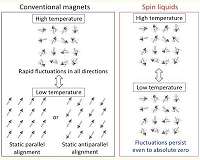
Differences between ordinary magnets and spin liquids. At high temperatures, the spins - the little compasses of each unpaired electron in the materials - fluctuate randomly between arbitrary orientations in both cases. (Left) In conventional magnetic states, the spins order statically aligning relative to each other either in parallel or antiparallel fashion below some characteristic temperature. (Right) In a quantum spin liquid, the spins never order at any temperature, no matter how low it is - they continue to fluctuate rapidly without symmetry breaking even at absolute zero temperature (- 273 C). Image courtesy Kosmas Prassides.

Fuel such as petrol is made up of hydrocarbons - a family of molecules consisting entirely of carbon and hydrogen. Pigment and dye, coal and tar are made up of hydrocarbons too.

These common, abundant materials, sometimes even associated with waste, are not often thought of as being electronically or magnetically interesting. But an international research team, led by Professor Kosmas Prassides of Tohoku University in Japan and Professor Matthew J. Rosseinsky of the University of Liverpool in the U.K., has made a significant find.

The team recently discovered how to take such hydrocarbon molecular components, dress them with electrons, each of which carries a small compass - an unpaired spin - and pack them together like cookies in a box to create a quantum spin liquid - a long-sought hypothetical state of matter.

It was in 1973 that the existence of quantum spin liquids was first theoretically proposed. In conventional magnets, the motion of the electron spins - the tiny magnets - freezes on cooling as they align parallel or antiparallel to each other.

In contrast, the spins in a quantum spin liquid never stop fluctuating, randomly and strongly, even at the lowest temperature of absolute zero. Each individual spin points simultaneously along an infinite number of directions and is highly entangled with other spins, even those far away. As such, this sea of electron spins is predicted to be host to many exotic phenomena of both fundamental and technological interest.

However, experimental realization of this unique fully-entangled state of matter has remained to date unfulfilled. Despite a four-decade-long search, there are very few quantum spin liquid candidates. Current options include certain copper inorganic minerals and some organic salts, which contain rare, heavy or toxic elements.

In results published in two back-to-back papers on April 24 in the British scientific journal Nature Chemistry, the team came up with the new chemistry needed to make high-purity crystalline materials from the reaction of polyaromatic hydrocarbons with alkali metals for the first time.

Materials obtained from polyaromatic hydrocarbons (molecules with many aromatic rings) were proposed in the past as candidates of new superconductors - materials with no electrical resistance and able to carry electricity without losing energy - devoid of toxic or rare elements. However, destruction of the molecular components in the synthetic treatments employed had inhibited any progress in this field.

"Removing the existing synthetic roadblock has led to very exciting developments," says Professor Kosmas Prassides. "We have already discovered that some of the structures of the new materials - made entirely of carbon and hydrogen, the simplest possible combination - show unprecedented magnetic properties - spin liquid behavior - with potential applications in superconductivity and quantum computing."

"It took us many years of work to achieve our breakthrough," adds Professor Matthew Rosseinsky. "But in the end, we succeeded in developing not one, but two complementary chemistry routes, which open the way to a rich variety of new materials with as-yet unknown properties."

Research paper

OIL AND GAS
Georgia formally ratifies EU energy treaty
Washington (UPI) Apr 25, 2017
Leaders from the European Union said Tuesday they welcomed Georgia, a former Soviet republic, as the latest member of the European energy community. All 89 members of the Georgian Parliament ratified an agreement Monday to align energy policies with the European Union. "The Energy Community welcomes Georgia's accession and the commitment for approximating Georgia's energy sector ... read more

Related Links
Tohoku University
All About Oil and Gas News at OilGasDaily.com


Thanks for being here;
We need your help. The Space Media Network continues to grow but revenues have never been harder to maintain.

With the rise of Ad Blockers, and Facebook - our traditional revenue sources via quality network advertising continues to decline. And unlike so many other news sites, we don't have a paywall - with those annoying usernames and passwords.

Our news coverage takes time and effort to publish 365 days a year.

If you find our news sites informative and useful then please consider becoming a regular supporter or for now make a one off contribution.
SpaceMediaNetwork Contributor
$5 Billed Once


credit card or paypal
SpaceMediaNetwork Monthly Supporter
$5 Billed Monthly


paypal only


Comment using your Disqus, Facebook, Google or Twitter login.

Share this article via these popular social media networks
del.icio.usdel.icio.us DiggDigg RedditReddit GoogleGoogle

OIL AND GAS
US missile defence equipment reaches S.Korea site

Seoul rejects Trump demand it pays for missile system

Syria to buy latest Russian anti-missile system: Assad

Israeli missile shoots down 'target' over Golan: army

OIL AND GAS
Russia's Brand-New S-500 Missile System to Have Unprecedented Damage Radius

Northrop to integrate missile countermeasure systems for Air Force, Navy

Raytheon receives $78 milllion contract for Sidewinder missiles

MBDA Systems gets $689M in U.K. missile contracts

OIL AND GAS
Service Academies Swarm Challenge Live-Fly Competition Begins

Dutch production facility opens for Predator B landing gear

Lockheed flies long-range endurance test flights of Fury unmanned aircraft

MQ-8C Fire Scout takes first flight from littoral combat ship

OIL AND GAS
MUOS Satellite Now Supporting Troops with Ultra High Frequency Communications

Navy's New Satellite Network to Be Fitted With Advanced Data Transfer Gear

U.S. Marine Corps tests WiFi system at its air stations

World's Most Powerful Emulator of Radio-Signal Traffic Opens for Business

OIL AND GAS
Canadian army to modernize training simulation system

Field trials underway for Russia's next-generation battle tank

Australia receives new Hercules armored recovery vehicles

Leidos to provide TUAS support for U.S. Army

OIL AND GAS
Dutch court jails Charles Taylor arms-supplier for 19 years

Canada moves to join treaty curbing foreign arms sales

India inks weapons deal worth nearly $2 bn with Israel

U.S. lawmakers push for Pentagon reforms

OIL AND GAS
China more interested in Macron's marriage than his politics

Philippines' Duterte says helpless against China

EU defence cooperation speeding up: Mogherini

China convicts US woman held for 'spying'

OIL AND GAS
Self-assembled nanostructures can be selectively controlled

Nanotubes that build themselves

Nanoparticles remain unpredictable

Better living through pressure: Functional nanomaterials made easy


The content herein, unless otherwise known to be public domain, are Copyright 1995-2024 - Space Media Network. All websites are published in Australia and are solely subject to Australian law and governed by Fair Use principals for news reporting and research purposes. AFP, UPI and IANS news wire stories are copyright Agence France-Presse, United Press International and Indo-Asia News Service. ESA news reports are copyright European Space Agency. All NASA sourced material is public domain. Additional copyrights may apply in whole or part to other bona fide parties. All articles labeled "by Staff Writers" include reports supplied to Space Media Network by industry news wires, PR agencies, corporate press officers and the like. Such articles are individually curated and edited by Space Media Network staff on the basis of the report's information value to our industry and professional readership. Advertising does not imply endorsement, agreement or approval of any opinions, statements or information provided by Space Media Network on any Web page published or hosted by Space Media Network. General Data Protection Regulation (GDPR) Statement Our advertisers use various cookies and the like to deliver the best ad banner available at one time. All network advertising suppliers have GDPR policies (Legitimate Interest) that conform with EU regulations for data collection. By using our websites you consent to cookie based advertising. If you do not agree with this then you must stop using the websites from May 25, 2018. Privacy Statement. Additional information can be found here at About Us.