
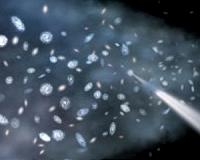
 A team of astronomers have obtained new data by studying quasars, which are very distant galaxies hosting an active black hole in their center. As the light emitted by quasars travels throughout the cosmos, part of it is absorbed by a variety of atoms present in interstellar clouds, providing astronomers with a natural laboratory to test the laws of physics billions of light-years away from the Earth. Credit: Dr. Julian Berengut, UNSW, 2010. |
These results will be presented tomorrow during the Joint European and National Astronomy Meeting in Lisbon, Portugal, and the scientific article has been submitted to the Physical Review Letters Journal.
A team of astronomers led by John Webb from the University of New South Wales, Australia, have obtained new data by studying quasars, which are very distant galaxies hosting an active black hole in their center.
As the light emitted by quasars travels throughout the cosmos, part of it is absorbed by a variety of atoms present in interstellar clouds, providing astronomers with a natural laboratory to test the laws of physics billions of light-years away from the Earth.
Webb's results imply that the fine-structure constant, which characterizes the strength of the electromagnetic force, might have different values depending on which direction we are looking in the sky, thus being not so 'constant' after all.
"The precision of astrophysical measurements of the fine-structure constant, or alpha, dramatically increased about a decade ago when Victor Flambaum and I introduced the 'Many-Multiplet Method', and since then evidence started mounting, suggesting this crucial physical quantity might not be the same everywhere in the Universe," says Webb.
The results obtained by Webb's team suggest that if there is any time-variation, it may be much less than the variation with position in the Universe. If correct, the new data indicates that new physics will be required to explain something so fundamental. The implications of these results are so resounding that they are likely to cause controversy in the scientific community.
Using two world-class observatories, the Keck Telescope and the European Southern Observatory's Very Large Telescope, Webb and his team observed the very energetic radiation coming from the most luminous objects in the universe: quasars.
Although quasars are incredibly far away, we can detect them from the Earth due to the sheer quantity of electromagnetic radiation that they emit, likely caused by material falling into supermassive black holes at their centers.
"The interaction of the light from the quasars with the gas clouds provides an impressive opportunity to investigate the physical conditions when the Universe was just a fraction of its current age," says PhD student Julian King, who played a major role in this research. "It is exciting that we have the technology to be able to measure the laws of physics in the early Universe so precisely," he added.
The new results collected by Webb and his team can be explained if our Universe is in fact exceptionally or indeed infinitely large, with fundamental quantities and 'constants' possessing different values from patch to patch. In such a scenario, we would exist in just a tiny part with correspondingly small changes in the physical constants.
This view raises a whole series of new questions on how 'alpha' and the other 'constants' have been so finely-tuned, in our local patch of the Universe, to develop physics and chemistry as we know them, and along them, life on Earth.
JENAM is organized each year in one of the European countries jointly by the European Astronomical Society (EAS) and one of the national astronomical societies. JENAM 2010 is the 18th Annual Meeting of the European Astronomical Society and the 20th Annual Portuguese Meeting of Astronomy and Astrophysics.
The European Astronomical Society (EAS) was founded in 1990 and its purpose is to contribute to and promote the advancement of astronomy, in its broadest sense, in Europe, by providing an independent forum for the discussion of subjects of common interest and by providing means whereby action can be taken on those matters which appear desirable to be handled at the European level. EAS brings together 24 European Astronomical Societies and more than 700 professional astronomers.
 del.icio.us del.icio.us |
 Digg Digg |
 Reddit Reddit |
 YahooMyWeb YahooMyWeb |
 Google Google |
 Facebook Facebook |

 Experiments Offer Tantalizing Clues As To Why Matter Prevails In The Universe
| The content herein, unless otherwise known to be public domain, are Copyright 1995-2010 - SpaceDaily. AFP and UPI Wire Stories are copyright Agence France-Presse and United Press International. ESA Portal Reports are copyright European Space Agency. All NASA sourced material is public domain. Additional copyrights may apply in whole or part to other bona fide parties. Advertising does not imply endorsement,agreement or approval of any opinions, statements or information provided by SpaceDaily on any Web page published or hosted by SpaceDaily. Privacy Statement |


