|
 |
 |
 |
 |
 |
 |
 |
 |
 |

| . |  |
. |
GLONASS To Be Made Available For Civilian Use In 2006
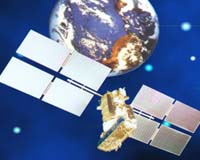
Moscow, Russia (RIA) Apr 03, 2006 The restrictions on precise satellite definition of on-land coordinates will be lifted by yearend, a senior military official said Friday. Lieutenant-General Valery Filatov said the location of geographical objects at accuracy of up to 30 meters would be available for civilian use from the Russian GLONASS satellite system and the U.S. Global Positioning System (GPS). He added that an exception would be made for top-secret facilities. Defense Minister Sergei Ivanov in February ordered that restrictions be lifted on civilian use of the systems this year, saying the move "would yield a considerable economic and anti-corruption effect." Experts say that in 10-15 years cellular phones, watches and car stereos will have receivers for satellite signals. The Glonass system currently has 17 satellites and two laser reflectors in orbit. The first launch under the project took place on October 12, 1982, but the system only officially came online on September 24, 1993. The satellites currently in use are of two modifications: Glonass and the updated Glonass-M. Glonass-M satellites have a longer service life of seven years and are equipped with updated antenna feeder systems and an additional navigation frequency for civilian users. A future modification, Glonass-K, is an entirely new model based on a non-pressurized platform, standardized to the specifications of the previous platform, the Express-1000. The Glonass-K is a small spacecraft that is considerably lighter than previous models, making it less expensive to put into orbit. Improved weight specifications also mean that more carrier rockets can carry it. The craft's estimated service life has been extended to 10-12 years and a third "civilian" L-range frequency added.
Source: RIA Novosti Related Links GLONASS Satellite System  New York School Districts Install GPS Tracking Systems in Buses
 Warrenville IL (SPX) Mar 23, 2006
Cutting-edge technology is making it easier for transportation directors to keep track of some school buses in New York. With the help of a global-positioning satellite (GPS) system installed in each of the school buses for a pilot testing program, school officials can locate exactly where their buses are at all times. |
|
|

| The content herein, unless otherwise known to be public domain, are Copyright 1995-2006 - SpaceDaily.AFP and UPI Wire Stories are copyright Agence France-Presse and United Press International. ESA PortalReports are copyright European Space Agency. All NASA sourced material is public domain. Additionalcopyrights may apply in whole or part to other bona fide parties. Advertising does not imply endorsement,agreement or approval of any opinions, statements or information provided by SpaceDaily on any Web page published or hosted by SpaceDaily. Privacy Statement |