|
 |
 |
 |
 |
 |
 |
 |
 |
 |

| . |  |
. |
Galileo Flirts With Amalthea But Zapped By Jupiter On The Final Pass
Pasadena - Nov 12, 2002 NASA's long-lived Galileo spacecraft achieved partial success in a dash through Jupiter's inner radiation belts and past the small moon Amalthea on Nov 4, its final flyby before a deliberate impact into Jupiter next September. This was Galileo's last flyby, after 37 other close encounters with various planets, asteroids and Jupiter's four large moons since launch 13 years ago. As the orbiter headed closer to Jupiter than it had ever ventured before, it gathered measurements of the energy fields and charged particles in the inner region of Jupiter's magnetic environment. It also examined dust grains that form a "gossamer" ring around the planet. However, Galileo placed itself in a standby precautionary mode after its closest approach to Amalthea. It flew past Amalthea at a targeted altitude of 160 kilometers (99 miles) at 06:19 Tuesday, Universal Time (10:19 p.m. Nov. 4, Pacific time), then went into "safe" mode about 30 minutes later. In that mode, onboard fault- protection software suspends many operations until receiving further instructions from the ground. "We knew this would be a challenging encounter for Galileo, so we are not surprised to have some things go awry," said Dr. Eilene Theilig, Galileo project manager at NASA's Jet Propulsion Laboratory, Pasadena, Calif. "Not only was the spacecraft going through a region with more intense radiation than it had ever experienced before, but it was also doing this after it had already survived four times the cumulative radiation dosage it was designed to take and had already operated nearly five years past its original mission." The flight team at JPL is working on recovery operations, diagnosing what happened and preparing new commands to Galileo that will restore the orbiter to normal and enable the playback of scientific data stored on the spacecraft's tape recorder. Two tape tracks of science data were recorded during the encounter period, out of four tracks planned. Also, the intended type of two-way radio link with Earth for the period closest to the flyby was not achieved. Now receding again from Jupiter, the spacecraft left the region of radiation danger about 11 hours after passing Amalthea. Amalthea orbits about halfway between Jupiter and Io, the innermost of the planet's four large moons. Amalthea is an elongated body, about 270 kilometers (168 miles) long. Galileo has nearly depleted its supply of the propellant needed for pointing its antenna toward Earth and controlling its flight path. While still controllable, it has been put on a course for impact into Jupiter. That's so there will be no risk of it drifting to an unwanted impact with the moon Europa, where Galileo discovered evidence of a subsurface ocean that is of interest as a possible habitat for extraterrestrial life. Sixty-four minutes after speeding over Amalthea's cratered surface, Galileo passed within about 71,400 kilometers (44,366 miles) of Jupiter's cloud tops. That marked the beginning of Galileo's final orbit, which will end with a plunge into the crushing pressure of Jupiter's atmosphere on Sept. 21, 2003. Going into a standby mode does not jeopardize Galileo's disposal at Jupiter. No further commanding of the spacecraft is necessary to assure that it is on an impact trajectory, Theilig said. Related Links Galileo SpaceDaily Search SpaceDaily Subscribe To SpaceDaily Express  Dark Rings By Jove
 Huntsville - Nov 11, 2002
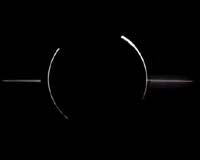
In 1974, NASA's Pioneer 11 spacecraft plunged through the rings of Jupiter. And no one noticed. Jupiter's dark rings--as wide as Saturn's yet nearly invisible--hadn't been discovered yet. Indeed, it wasn't until five years later that cameras onboard Voyager 1 caught sight of them for the first time. On Mar. 5, 1979, the spacecraft swung behind Jupiter, and from inside the planet's shadow the faintly sunlit rings were visible--but just barely. |
|
|

| The content herein, unless otherwise known to be public domain, are Copyright 1995-2006 - SpaceDaily.AFP and UPI Wire Stories are copyright Agence France-Presse and United Press International. ESA PortalReports are copyright European Space Agency. All NASA sourced material is public domain. Additionalcopyrights may apply in whole or part to other bona fide parties. Advertising does not imply endorsement,agreement or approval of any opinions, statements or information provided by SpaceDaily on any Web page published or hosted by SpaceDaily. Privacy Statement |