In a series of landmark observations gathered over a period of four months, NASA's Swift satellite has challenged some of astronomers' fundamental ideas about gamma-ray bursts (GRBs), which are among the most extreme events in our universe. GRBs are the explosive deaths of very massive stars, some of which eject jets that can release in a matter of seconds the same amount of energy that the sun will radiate over its 10-billion-year lifetime.
When GRB jets slam into nearby interstellar gas, the resulting collision generates an intense afterglow that can radiate brightly in X-rays and other wavelengths for several weeks. Swift, however, has monitored a GRB whose afterglow remained visible for more than 125 days in the satellite's X-ray Telescope (XRT).
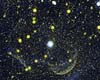
Swift's Burst Alert Telescope (BAT) detected the GRB in the constellation Pictor on July 29, 2006. The XRT picked up GRB 060729 (named for its date of detection) 124 seconds after BAT's detection. Normally, the XRT monitors an afterglow for a week or two until it fades to near invisibility. But for the July 29 burst, the afterglow started off so bright and faded so slowly that the XRT could regularly monitor it for months, and the instrument was still able to detect it in late November. The burst's distance from Earth (it was much closer than many GRBs) was also a factor in XRT's ability to monitor the afterglow for such an extended period.
The slow fading of the X-ray afterglow has several important ramifications for our understanding of GRBs. "It requires a larger energy injection than what we normally see in bursts, and may require continuous energy input from the central engine," says astronomer Dirk Grupe of Penn State University, University Park, Penn., and lead author of an international team that reports these results in an upcoming issue of the Astrophysical Journal.
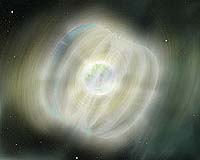
One possibility is that the GRB's central engine was a magnetar - a neutron star with an ultra-powerful magnetic field. The magnetar's magnetic field acts like a brake, forcing the star's rotation rate to spin-down rapidly. The energy of this spin-down can be converted into magnetic energy that is continuously injected into the initial blast wave that triggered the GRB. Calculations by paper coauthor Xiang-Yu Wang of Penn State show that this energy could power the observed X-ray afterglow and keep it shining for months.
A burst observed on January 10, 2007, also suggests that magnetars power some GRBs. GRB 070110's X-ray afterglow remained nearly constant in brightness for 5 hours, then faded rapidly more than tenfold. In another paper submitted to the Astrophysical Journal, an international group led by Eleonora Troja of the INAF-IASF of Palermo, Italy, proposes that a magnetar best explains these observations.
"People have thought for a long time that GRBs are black holes being born, but scientists are now thinking of other possibilities," says Swift principal investigator Neil Gehrels of NASA's Goddard Space Flight Center in Greenbelt, Md., a co-author on both studies.
Another surprising result from GRB 060729 is that the X-ray afterglow displayed no sharp decrease in brightness over the 125-day period that it was detected by the XRT. Using widely accepted theory, Grupe and his colleagues conclude that the angle of the GRB's jet must have been at least 28 degrees wide. In contrast, most GRB jets are thought to have very narrow opening angles of only about 5 degrees. "The much wider opening angle seen in GRB 060729 suggests a much larger energy release than we typically see in GRBs," says Grupe.