. Military Space News .
Gargantuan Galaxy NGC 1132 - A Cosmic Fossil

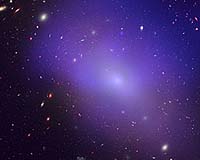
This image of the elliptical galaxy NGC 1132 combines an image from NASA's Chandra X-Ray Observatory obtained in 2004 with images from the NASA/ESA Hubble Space Telescope made in 2005 and 2006 in green and near-infrared light. The blue/purple in the image is the X-ray glow from hot, diffuse gas. The giant foreground galaxy, numerous dwarf galaxies in its neighbourhood, and many much more distant galaxies in the background are seen in visible light. Credit: NASA, ESA, M. West (ESO, Chile), and CXC/Penn State University/G. Garmire, et al.
by Staff Writers
Paris, France (ESA) Feb 08, 2008
The NASA/ESA Hubble Space Telescope has captured a new image of the galaxy NGC 1132 which is, most likely, a cosmic fossil - the aftermath of an enormous multi-galactic pile-up, where the carnage of collision after collision has built up a brilliant but fuzzy giant elliptical galaxy far outshining typical galaxies.

The elliptical galaxy NGC 1132, seen in this latest image from Hubble, belongs to a category of galaxies called giant ellipticals. NGC 1132, together with the small dwarf galaxies surrounding it, are dubbed a "fossil group" as they are most likely the remains of a group of galaxies that merged together in the recent past.

In visible light NGC 1132 appears as a single, isolated, giant elliptical galaxy, but this is only the tip of the iceberg. Scientists have found that NGC 1132 resides in an enormous halo of dark matter, comparable to the amount of dark matter usually found in an entire group of tens or hundreds of galaxies.

It also has a strong X-ray glow from an abundant amount of hot gas - an amount normally only found in galaxy groups. Its X-ray glow extends over a region of space ten times larger than the 120,000 light-year radius it has in visible light. An X-ray glow that is equal in size to that of an entire group of galaxies.

The origin of fossil group systems remains a puzzle. The most likely explanation is that they are the end-products of a cosmic feeding frenzy in which a large cannibal galaxy devours all of its neighbours. A less likely explanation is that they may be very rare objects that formed in a region or period of time where the growth of moderate-sized galaxies was somehow suppressed, and only one large galaxy formed.

Many galaxies reside in groups that are gravitationally bound together, including our own Milky Way, which is part of the Local Group. Sometimes gravity makes galaxies collide and eventually merge into one single galaxy. There is strong evidence that the Milky Way is one such cannibal that has snacked on numerous smaller galaxies during its lifetime, inheriting their stars in the process.

Scientists are keenly studying the environment surrounding galaxies such as NGC 1132 using space telescopes like Hubble, and they try to trace the history of the formation these galaxies by analysing their properties.

In this Hubble image, NGC 1132 is seen surrounded by thousands of ancient globular clusters, swarming around the galaxy like bees around a hive. These globular clusters are likely to be the survivors of the disruption of their cannibalised parent galaxies that have been eaten by NGC 1132 and may reveal its merger history. In the background, there is a stunning tapestry of numerous galaxies that are much further away.

Elliptical galaxies are smooth and featureless. They contain hundreds of millions to trillions of stars, and their shapes range from nearly spherical to very elongated in shape. Their overall yellowish colour is a telltale sign of their great age. Because elliptical galaxies do not contain much cool gas they can no longer make new stars.

NGC 1132 is located approximately 320 million light-years away in the constellation of Eridanus, the River. This image of NGC 1132 was taken with Hubble's Advanced Camera for Surveys. Data obtained in 2005 and 2006 through green and near-infrared filters were used to produce a colour composite.
Community
Email This Article
Comment On This Article

Related Links
ESA Hubble
Stellar Chemistry, The Universe And All Within It


Memory Foam Mattress Review
Newsletters :: SpaceDaily :: SpaceWar :: TerraDaily :: Energy Daily
XML Feeds :: Space News :: Earth News :: War News :: Solar Energy News


Cool Spacedust Survey Goes Into Orbit
Nottingham, UK (SPX) Feb 04, 2008
University of Nottingham astronomers will be studying icy cosmic dust millions of light years away - using the biggest space telescope ever built. Scientists at the School of Physics and Astronomy will be using the Herschel Space Observatory, the most powerful telescope ever launched into space, as part of a giant survey to find out more about some of the coldest objects in the Universe.


  • China's Military Hardware Doctrine For The Early 21st Century Part Two
  • Military Matters: Rebuilding states
  • US-China developing better military ties: US admiral
  • India showcases military might

  • Skipping The Nuke Dance North Of The 38th Parallel Part One
  • India invites Western observers to nuclear site war games
  • Disabling NKorea's nuclear programs almost completed: US
  • North Korea still a nuclear proliferation risk: intel report

  • Lockheed Martin Receives New Contract For Army Tactical Missile System
  • Iran Iran Tests Sounding Rocket And Unveils First Homemade Satellite
  • Raytheon Completes Second Engine Test Of Joint Standoff Weapon Extended Range
  • France And US Sign Agreement For Sale Of Lockheed Martin Hellfire II Missiles

  • US missile plan is surrounding Russia: Lavrov
  • Israelis told to prepare 'rocket rooms' for war
  • US missile shield to 'keep an eye' on Russian weapons: Moscow
  • Japan boosts missile defences in Tokyo

  • Birds Bats And Insects Hold Secrets For Aerospace Engineers
  • British-designed jet could reach Australia in under five hours
  • Flapping-wing airplanes are envisioned
  • Whale-shaped floating hotel set for flight

  • Northrop Grumman's Global Hawk UAS Surpasses Expectations, Establishes Delivery Record In 2007
  • Iraq War See Widespread Use Of Unmanned Air Vehicles
  • BAE Systems Delivers UAV Target Detection Systems To US Army
  • Unmanned Aerial Vehicles Show Battlefield To Soldiers

  • Outside View: Ahmadinejad goes to Baghdad
  • US to make no commitments to Iraq's defense: Gates
  • Bush Requests Half A Trillion Dollars For Next Defense Budget
  • Analysis: Rules stop U.S. entering mosques

  • BAE Systems Launches ECLiPSE Performance Military Gear Product Line
  • Thales And Boeing Sign FRES Contract With UK MoD
  • France Awards Raytheon Contract For Enhanced Paveway II
  • Production Begins On First F/A-18F Super Hornet For Royal Australian Air Force

  • The content herein, unless otherwise known to be public domain, are Copyright 1995-2007 - SpaceDaily.AFP and UPI Wire Stories are copyright Agence France-Presse and United Press International. ESA Portal Reports are copyright European Space Agency. All NASA sourced material is public domain. Additional copyrights may apply in whole or part to other bona fide parties. Advertising does not imply endorsement,agreement or approval of any opinions, statements or information provided by SpaceDaily on any Web page published or hosted by SpaceDaily. Privacy Statement