|
 |
 |
 |
 |
 |
 |
 |
 |
 |

| . |  |
. |
German whizzkid got it wrong: NASA
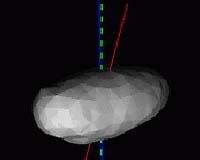
Washington (AFP) April 16, 2008 It was an incredible tale of a German schoolboy spotting a miscalculation by the US space agency, proving the chances of an asteroid hitting the Earth were higher than initially believed. But the amazing story of the whizzkid versus the space bureaucracy turned out to be wrong, the National Aeronautics and Space Administration said Wednesday. The agency, sounding a bit like a weary math teacher, said its figures are correct when it comes to the asteroid Apophis, not the boy's. "We stand by our numbers," NASA spokesman Dwayne Brown told AFP. The agency that oversees space shuttle missions and unmanned space probes issued a statement after the German newspaper Potsdamer Neuerster Nachrichten reported on Tuesday that student Nico Marquardt had calculated there was a 1 in 450 chance that the Apophis asteroid will collide with Earth. He argued in his project for a regional science competition that scientists at NASA had got it wrong when they estimated the chances of a collision at only 1 in 45,000. But experts at the agency's Jet Propulsion Laboratory in Pasadena, California had no doubts about their calculations, Brown said. The Near-Earth Object Program Office "has not changed its current estimates for the very low probability (1 in 45,000) of an Earth impact by the asteroid Apophis in 2036," Brown said in a statement. And the newspaper's account was also inaccurate when it described NASA telling the European Space Agency that the German student's calculations were correct, Brown said. "Contrary to recent press reports, NASA offices involved in near-Earth object research were not contacted and have had no correspondence with a young German student, who claims the Apophis impact probability is far higher than the current estimate," the statement said. The student's estimates were reportedly based on the asteroid hitting a satellite in 2029. "However, the asteroid will not pass near the main belt of geosynchronous satellites in 2029, and the chance of a collision with a satellite is exceedingly remote," it said. While the German newspaper article had spread across the Internet, NASA said the probability of Apophis colliding with Earth remained at 1 in 45,000. Community Email This Article Comment On This Article Related Links Asteroid and Comet Mission News, Science and Technology
 Confusion Over Asteroid Calculation Sorted As NASA Issues Clarification
 Pasadena CA (JPL) Apr 16, 2008
A 13-year-old German schoolboy corrected NASA's estimates on the chances of an asteroid colliding with Earth, a German newspaper reported Tuesday, after spotting the boffins had miscalculated. |
|
|

| The content herein, unless otherwise known to be public domain, are Copyright 1995-2007 - SpaceDaily.AFP and UPI Wire Stories are copyright Agence France-Presse and United Press International. ESA Portal Reports are copyright European Space Agency. All NASA sourced material is public domain. Additional copyrights may apply in whole or part to other bona fide parties. Advertising does not imply endorsement,agreement or approval of any opinions, statements or information provided by SpaceDaily on any Web page published or hosted by SpaceDaily. Privacy Statement |