
 |
 |
 |
 |
 |
 |
 |
 |
 |
 |

| . |  |
. |
Ghostly Glow Reveals Galaxy Clusters In Collision
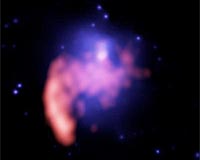
Washington DC (SPX) Oct 17, 2008 A team of scientists, including astronomers from the Naval Research Laboratory (NRL), have detected long wavelength radio emission from a colliding, massive galaxy cluster which, surprisingly, is not detected at the shorter wavelengths typically seen in these objects. The discovery implies that existing radio telescopes have missed a large population of these colliding objects. It also provides an important confirmation of the theoretical prediction that colliding galaxy clusters accelerate electrons and other particles to very high energies through the process of turbulent waves. The team revealed their findings in the October 16, 2008 edition of Nature. This new population of objects is most easily detected at long wavelengths. Professor Greg Taylor of the University of New Mexico and scientific director of the Long Wavelength Array (LWA) points out, "This result is just the tip of the iceberg. When an emerging suite of much more powerful low frequency telescopes, including the LWA in New Mexico, turn their views to the cosmos, the sky will 'light up' with hundreds or even thousands of colliding galaxy clusters." NRL has played a key role in promoting the development of this generation of new instruments and is currently involved with the development of the LWA. NRL radio astronomer and LWA Project Scientist Namir Kassim says "Our discovery of a previously hidden class of low frequency cluster-radio sources is particularly important since the study of galaxy clusters was a primary motivation for development of the LWA." The discovery of the emission in the galaxy cluster Abell 521 (or A521 for short) was made using the Giant Metrewave Radiotelescope (GMRT) in India, and its long wavelength nature was confirmed by the National Science Foundation's (NRAO) Very Large Array (VLA) radio telescope in New Mexico. The X-ray emission comes from hot thermal gas, a well-known sign-post of massive galaxy clusters. Furthermore, its elongated shape indicates that the cluster has undergone a recent violent collision or "merger event" in which another group or cluster of galaxies was swallowed up by the gravitational potential of the main cluster. Interferometrics Inc. and NRL scientist Tracy Clarke, who is also the LWA System Scientist, notes "In addition to teaching us about the nature of Dark Matter, merging clusters are also important in studies of the mysterious nature of Dark Energy. Understanding these two strange components of the Universe will help us understand its ultimate destiny." In the radio image there is a strong, oblong source of emission located on the lower left periphery of the X-ray gas detected by Chandra; this is a separate source. In the center of the cluster, within the region indicated by a dashed circle, there is radio emission which changes significantly with wavelength. At the longest wavelength (125 cm, shown) it is clearly detected, but at a wavelength of 49 cm it is much fainter, and it is almost entirely gone at 21 cm wavelength. This multi-wavelength picture of the diffuse emission is in good agreement with theoretical predictions for particle acceleration by turbulent waves generated by a violent collision. In a broader astrophysical context, galaxy clusters are the largest gravitationally bound systems in the Universe and their collisions are the most energetic events since the Big Bang. Says team leader Gianfranco Brunetti (Instituto di Radioastronomia, Bologna, Italy), "The A521 system provides evidence that turbulence acts as a source of particle acceleration in an environment that is unique in the Universe due to its large spatial and temporal scales, and due to the low density and high temperature of the gas." Community Email This Article Comment On This Article Share This Article With Planet Earth
Related Links Naval Research Laboratory Stellar Chemistry, The Universe And All Within It
 The Magellanic Group And Its Seven Dwarf Galaxies
 Zurich, Switzerland (SPX) Oct 15, 2008
Astronomers at the University of Zurich have proposed a new theory for the formation of dwarf galaxies. In a paper published in "The Astrophysical Journal", Elena D'Onghia and George Lake solve several outstanding problems by comparing observed dwarfs to supercomputer simulations of their formation. |
|
|

| The content herein, unless otherwise known to be public domain, are Copyright 1995-2007 - SpaceDaily.AFP and UPI Wire Stories are copyright Agence France-Presse and United Press International. ESA Portal Reports are copyright European Space Agency. All NASA sourced material is public domain. Additional copyrights may apply in whole or part to other bona fide parties. Advertising does not imply endorsement,agreement or approval of any opinions, statements or information provided by SpaceDaily on any Web page published or hosted by SpaceDaily. Privacy Statement |
 del.icio.us
 Digg
Digg Reddit
 YahooMyWeb
 Google
 Facebook