
 |
 |
 |
 |
 |
 |
 |
 |
 |
 |

| . |  |
. |

Washington DC (SPX) Mar 22, 2011 Poorly aimed and unshielded outdoor lights are more than an annoyance. They waste more than $2 billion (17 billion kilowatt-hours) of energy in the United States each year. Poorly shielded roadway lights are also a safety and glare hazard, especially for older citizens. Under an unpolluted sky we ought to see more than 2,000 stars, yet we see less than a hundred from many cities. The Milky Way is unknown to most city dwellers. GLOBE at Night is an international campaign run each spring for the last six years by the National Optical Astronomy Observatory in Tucson. The program invites citizen scientists to track outdoor lighting levels and submit their observations to a website from a computer or smart phone. The campaign runs March 22 through April 4 in the northern hemisphere and March 24 through April 6 in the southern hemisphere. Over the last six annual 2-week campaigns, citizen scientists from more than 100 nations have contributed 61,000 measurements (see the accompanying image). The night sky brightness can be measured by anyone using a simple star map provided by the project. The measurements provide a valuable resource for teachers, scientists, city planners, and policy makers to track and address wasted light/energy issues. "Monitoring our night sky by citizen scientists is invaluable in identifying areas where the glare of unshielded lighting may be hazardous and where energy is being wasted." said GLOBE at Night Project Director, Dr. Connie Walker of the National Optical Astronomy Observatory. "All it takes is a few minutes for a family to measure their night sky brightness by noting how many stars are missing from an easy-to-find constellation like Leo (in the northern hemisphere) or Crux (in the southern hemisphere). This tells us how much light is directed upwards into the sky." Across the country, people are recording the night sky brightness level in their neighborhoods. This information can be used in local decisions on how to increase safety, lower energy consumption, and protect human health - areas affected by high levels of extraneous light. These observations will also help identify parks suitable for urban "sky oases" - places that can be developed to help city dwellers appreciate the night sky from a safe, dark place. The GLOBE at Night program motto is "Less of Our Light for More Star Light: Saving Energy, Saving Our Night Skies." Walker feels strongly that the program is most important in cities far from telescopes and observatories. "We need to improve our outdoor lighting fixtures and practices; many of our current lights waste a tremendous amount of valuable energy and the beauty of our night sky. Thanks to thousands of citizen scientists participating in GLOBE at Night, we are working to preserve both of these important resources."
Share This Article With Planet Earth
Related Links GLOBE at Night Stellar Chemistry, The Universe And All Within It

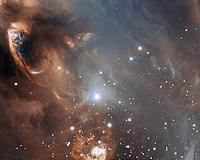 Newborn Stars Wreak Havoc In Their Nursery
Paris, France (SPX) Mar 17, 2011 A new image from ESO's Very Large Telescope gives a close-up view of the dramatic effects newborn stars have on the gas and dust from which they formed. Although the stars themselves are not visible, material they have ejected is colliding with the surrounding gas and dust clouds and creating a surreal landscape of glowing arcs, blobs and streaks. The star-forming region NGC 6729 is part o ... read more |
|
|
| The content herein, unless otherwise known to be public domain, are Copyright 1995-2010 - SpaceDaily. AFP and UPI Wire Stories are copyright Agence France-Presse and United Press International. ESA Portal Reports are copyright European Space Agency. All NASA sourced material is public domain. Additional copyrights may apply in whole or part to other bona fide parties. Advertising does not imply endorsement,agreement or approval of any opinions, statements or information provided by SpaceDaily on any Web page published or hosted by SpaceDaily. Privacy Statement |


 del.icio.us
 Digg
Digg Reddit
 YahooMyWeb
 Google
 Facebook


