|
 |
 |
 |
 |
 |
 |
 |
 |
 |

| . |  |
. |
Going To Mercury? Don't Leave Home Without A NIST Calibration
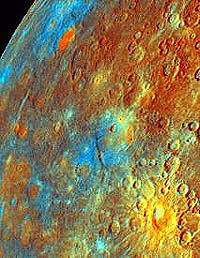
Gaithersburg MD (SPX) Aug 20, 2004 The first spacecraft intended to orbit Mercury was launched on Aug. 3, 2004, carrying an instrument for mapping the composition of the planet's crust that was calibrated with a novel procedure at the National Institute of Standards and Technology (NIST). The procedure, using NIST-produced, high-energy gamma rays, enabled the device to be prepared for the same intense radiation levels typically produced in outer space. Mercury is a rocky planet like the Earth but smaller, denser and with an older surface. Scientists believe that by studying Mercury they can develop a better understanding of how the Earth formed, evolved and interacts with the Sun. Scheduled to orbit Mercury in 2011, the National Aeronautics and Space Administration's (NASA) Messenger (MErcury Surface, Space ENvironment, GEochemistry, and Ranging) spacecraft carries seven scientific instruments, including a detector that will measure gamma rays emitted by Mercury's crust as it is bombarded by cosmic rays. The bombardment releases neutrons, which react with the elements in the crust; analysis of the resulting gamma rays will help identify the elements. The detector's efficiency (the fraction of incoming gamma rays detected) needed to be calibrated based on the gamma-ray energy for 37 different orientation angles associated with the orbits around the planet. Typical gamma ray sources, such as those used for medical treatments, emit at lower energy levels than those needed for the calibration. NIST scientists, in collaboration with the mission's prime contractor, the Johns Hopkins University Applied Physics Laboratory, solved the calibration problem by using a high-intensity neutron beam to irradiate targets made of sodium chloride and chromium. The targets captured neutrons and emitted gamma rays, which were measured by Messenger's gamma-ray detector. These gamma rays spanned the energy range that will be measured in the planetary assay. According to Johns Hopkins' Edgar A. Rhodes - lead scientist for the Messenger instrument - the calibration procedure "will likely set a new standard for space-flight gamma-ray spectrometers." Related Links SpaceDaily Search SpaceDaily Subscribe To SpaceDaily Express  Venus: Inhabited World?
 Moffett Field CA (SPX) Aug 19, 2004
In part 1 of this interview with Astrobiology Magazine editor Henry Bortman, planetary scientist David Grinspoon explained how Venus evolved from a wet planet similar to Earth to the scorching hot, dried-out furnace of today. In part 2, Grinspoon discusses the possibility of life on Venus. |
|
|

| The content herein, unless otherwise known to be public domain, are Copyright 1995-2006 - SpaceDaily.AFP and UPI Wire Stories are copyright Agence France-Presse and United Press International. ESA PortalReports are copyright European Space Agency. All NASA sourced material is public domain. Additionalcopyrights may apply in whole or part to other bona fide parties. Advertising does not imply endorsement,agreement or approval of any opinions, statements or information provided by SpaceDaily on any Web page published or hosted by SpaceDaily. Privacy Statement |