
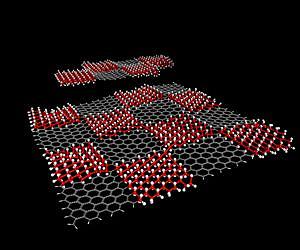
The future brightened for organic chemistry when researchers at Rice University found a highly controllable way to attach organic molecules to pristine graphene, making the miracle material suitable for a range of new applications.
The Rice lab of chemist James Tour, building upon a set of previous finds in the manipulation of graphene, discovered a two-step method that turned what was a single-atom-thick sheet of carbon into a superlattice for use in organic chemistry. The work could lead to advances in graphene-based chemical sensors, thermoelectric devices and metamaterials.
The work appeared this week in the online journal Nature Communications.
Graphene alone is inert to many organic reactions and, as a semimetal, has no band gap; this limits its usefulness in electronics. But the project led by the Tour Lab's Zhengzong Sun and Rice graduate Cary Pint, now a researcher at Intel, demonstrated that graphene, the strongest material there is because of the robust nature of carbon-carbon bonds, can be made suitable for novel types of chemistry.
Until now there was no way to attach molecules to the basal plane of a sheet of graphene, said Tour, Rice's T.T. and W.F. Chao Chair in Chemistry as well as a professor of mechanical engineering and materials science and of computer science. "They would mostly go to the edges, not the interior," he said.
"But with this two-step technique, we can hydrogenate graphene to make a particular pattern and then attach molecules to where those hydrogens were.
"This is useful to make, for example, chemical sensors in which you want peptides, DNA nucleotides or saccharides projected upward in discrete places along a device. The reactivity at those sites is very fast relative to placing molecules just at the edges. Now we get to choose where they go."
The first step in the process involved creating a lithographic pattern to induce the attachment of hydrogen atoms to specific domains of graphene's honeycomb matrix; this restructure turned it into a two-dimensional, semiconducting superlattice called graphane.
The hydrogen atoms were generated by a hot filament using an approach developed by Robert Hauge, a distinguished faculty fellow in chemistry at Rice and co-author of the paper.
The lab showed its ability to dot graphene with finely wrought graphane islands when it dropped microscopic text and an image of Rice's classic Owl mascot, about three times the width of a human hair, onto a tiny sheet and then spin-coated it with a fluorophore.
Graphene naturally quenches fluorescent molecules, but graphane does not, so the Owl literally lit up when viewed with a new technique called fluorescence quenching microscopy (FQM).
FQM allowed the researchers to see patterns with a resolution as small as one micron, the limit of conventional lithography available to them. Finer patterning is possible with the right equipment, they reasoned.
In the next step, the lab exposed the material to diazonium salts that spontaneously attacked the islands' carbon-hydrogen bonds. The salts had the interesting effect of eliminating the hydrogen atoms, leaving a structure of carbon-carbon sp3 bonds that are more amenable to further functionalization with other organics.
"What we do with this paper is go from the graphene-graphane superlattice to a hybrid, a more complicated superlattice," said Sun, who recently earned his doctorate at Rice.
"We want to make functional changes to materials where we can control the position, the bond types, the functional groups and the concentrations.
"In the future – and it might be years – you should be able to make a device with one kind of functional growth in one area and another functional growth in another area. They will work differently but still be part of one compact, cheap device," he said. "In the beginning, there was very little organic chemistry you could do with graphene. Now we can do almost all of it. This opens up a lot of possibilities."
The paper's co-authors are graduate students Daniela Marcano, Gedeng Ruan and Zheng Yan, former graduate student Jun Yao, postdoctoral researcher Yu Zhu and visiting student Chenguang Zhang, all of Rice.
The work was supported by the Air Force Office of Scientific Research, Sandia National Laboratory, the Nanoscale Science and Engineering Initiative of the National Science Foundation and the Office of Naval Research MURI graphene program.
