
 |
 |
 |
 |
 |
 |
 |
 |
 |
 |

| . |  |
. |

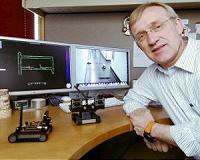
Los Angeles CA (SPX) May 27, 2011 For the visually impaired, navigating city streets or neighborhoods has constant challenges. And most such people still must rely on a very rudimentary technology - a simple cane - to help them make their way through a complex world. A group of University of Southern California engineering researchers is working to change that by developing a robot vision-based mobility aid for the visually impaired. A design first shown a year ago is now being further developed. The need is clear. According to the World Health Organization, 39 million people worldwide are totally blind and a much larger number, 284 million people, are visually impaired. In the United States, according to the American Foundation for the Blind, 109,000 visually impaired people use long white canes to get around. Guide dogs? About 7,000 nationwide. "There are many limitations to canes for the visually impaired, from low hanging branches to large objects," according to Gerard Medioni, a professor in the Institute for Robotics and Intelligent Systems at USC Viterbi. "We wanted to build an effective system that would provide new opportunities for the visually impaired." Medioni and his colleagues, including James Weiland, a Viterbi School associate professor of biomedical engineering who is also a professor of ophthalmology at the USC Keck School of Medicine's Doheny Eye Institute; and Vivek Pradeep, a recent Viterbi Ph.D who is now at the Applied Sciences Group of Microsoft, have developed software that "sees" the world, and linked it to a system that provides tactile messages to alert users about objects in their paths. Pradeep won the 2010 USC Department of Biomedial Engineering Grodins Graduate Research Award and a USC Stevens Institute 'most inventive' award for his work on the system. The system uses cameras worn on the head connected to PCs that use Simultaneous Localization and Mapping (SLAM) software to build maps of the environment and identify a safe path through obstacles. This route information is conveyed to the user through a guide vest that includes four micro motors located on an individual's shoulder and waist that vibrate like cell phones. For example, a vibration on the left shoulder indicates a higher object to the left, such as a low-hanging branch, and the individual can in turn use that information to take a new path. Medioni said that canes have clear limitations with larger objects, from walls to concrete structures, and the technology will enable users to avoid falls and injuries. The USC team tested the system on blind subjects at the Braille Institute. The users there "like the system, and they feel it really helps them," Medioni said. "We greatly appreciate the cooperation and help of the Institute and the test subjects," added Weiland. Medioni is pleased with the prototype of the system presented at the 2010 International IEEE Engineering in Medicine and Biology Society (EMBS) Conference, and more recently, May 1 at the 2011 meeting of Association for Research in Vision and Opthalmology. But he and the team are now working to improve it. The current head-mounted camera is bulky, and the team is now working on a micro-camera system that could be attached to glasses. The goal is to have a new system in place by the end of 2011, he said.
Share This Article With Planet Earth
Related Links University of Southern California All about the robots on Earth and beyond!

 Researchers demonstrate autonomous robots able to explore and map buildings
Atlanta GA (SPX) May 18, 2011 There isn't a radio-control handset in sight as several small robots roll briskly up the hallways of an office building. Working by themselves and communicating only with one another, the vehicles divide up a variety of exploration tasks - and within minutes have transmitted a detailed floor map to humans nearby. This isn't a future-tech scenario. This advanced autonomous capability has be ... read more |
|
|
| The content herein, unless otherwise known to be public domain, are Copyright 1995-2010 - SpaceDaily. AFP and UPI Wire Stories are copyright Agence France-Presse and United Press International. ESA Portal Reports are copyright European Space Agency. All NASA sourced material is public domain. Additional copyrights may apply in whole or part to other bona fide parties. Advertising does not imply endorsement,agreement or approval of any opinions, statements or information provided by SpaceDaily on any Web page published or hosted by SpaceDaily. Privacy Statement |


 del.icio.us
 Digg
Digg Reddit
 YahooMyWeb
 Google
 Facebook


