|
 |
 |
 |
 |
 |
 |
 |
 |
 |

| . |  |
. |
HESS J1616-508 Likely Powered by Young Pulsar PSR J1617-5055
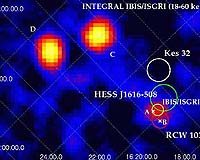
Paris, France (ESA) Aug 10, 2007 By combining X-ray and gamma ray observations from the INTEGRAL, XMM-Newton, Swift and BeppoSAX satellites, a group of astronomers have identified a very likely source of power for the bright TeV source HESS J1616-508. The data covers the sky around HESS J1616-508 that contains several sources detected at X-ray and gamma ray energies, none of which however were as yet firmly identified as a counterpart for the bright TeV source. HESS J1616-508 is one of the brightest sources in the sky at TeV energies. It was discovered in a survey of the inner part of the Galactic Plane (Galactic longitude -30 degrees < l < 30 degrees and latitude -3 degrees < b < 3 degrees) performed with the ground based High Energy Stereoscopic System (HESS) in early 2004 - see related publication by Aharonian, F. et al. [2005]. In addition to HESS J1616-508, the HESS survey detected seven other new sources at high energies, above 100 GeV. HESS J1616-508 is nearly circular in shape with an apparent diameter of 16' and to date no counterpart has been detected within its extension at other wavelengths. Surrounding the bright and stable TeV source however, are several energetic astronomical objects, including two supernova remnants - RCW 103 and Kes 32 - and the X-ray bright pulsar PSR J1617-5055 (see above images of the region in soft gamma rays and X-rays). PSR J1617-5055 The young pulsar PSR J1617-5055 is located only 9' from the centre of the HESS J1616-508 TeV extension. It is labelled as A in figure 1 and 2. Reported in the paper by Landi et al. [2007] recent observations by INTEGRAL show it to be a powerful source of soft gamma rays between 17 and 300 keV (figure 1 and 3). Landi et al. also show that data from both BeppoSAX and XMM-Newton prove the pulsar to be the only stable source at energies above a few keV in the region surrounding HESS J1616-508. The X-ray bright source 1E 161348-5055.1 (labelled as B in figure 1 and 2) at the centre of the supernova remnant RCW 103 is discarded as a possible counterpart for the TeV source, mainly due to its high variability. Models of the pulsar PSR J1617-5055 with electrons being accelerated in a jet can satisfactorily account for the pulsar's observed X-ray and gamma ray emission as well as the bright TeV emission in the adjacent HESS J1616-508 extension. To explain the latter, lower energy electrons from the pulsar are thought to interact with photons from the Cosmic Microwave Background (CMB) and through inverse Compton scattering accelerate the CMB photons to TeV energies. The combined measurements lead the authors to conclude that the pulsar is the most likely source of the bright TeV emission identified as HESS J1616-508. This in favour of two other possibilities: 1) the source is coincident with the TeV emission region but too weak at other wavelengths to be detectable, 2) the existence of a dark particle accelerator which has no associated X-ray and radio emission. + see this page for detailed images and captions referred to in this reports Related Publications: Landi, R. et al. 2007, HESS J1616-508: likely powered by PSR J1617-5055, astro-ph(0707.0832), M.N.R.A.S. in press. Aharonian, F. et al. 2005, A New Population of Very High Energy Gamma-Ray Sources in the Milky Way, Science, 307, 5717, pp. 1938-1942 Community Email This Article Comment On This Article Related Links INTEGRAL INTEGRAL Science Operation Centre (ISOC) The HESS project Stellar Chemistry, The Universe And All Within It
 Spitzer Spies Monster Galaxy Pileup
 Pasadena CA (JPL) Aug 07, 2007
Four galaxies are slamming into each other and kicking up billions of stars in one of the largest cosmic smash-ups ever observed. The clashing galaxies, spotted by NASA's Spitzer Space Telescope, will eventually merge into a single, behemoth galaxy up to 10 times as massive as our own Milky Way. This rare sighting provides an unprecedented look at how the most massive galaxies in the universe form. |
|
|

| The content herein, unless otherwise known to be public domain, are Copyright 1995-2006 - SpaceDaily.AFP and UPI Wire Stories are copyright Agence France-Presse and United Press International. ESA PortalReports are copyright European Space Agency. All NASA sourced material is public domain. Additionalcopyrights may apply in whole or part to other bona fide parties. Advertising does not imply endorsement,agreement or approval of any opinions, statements or information provided by SpaceDaily on any Web page published or hosted by SpaceDaily. Privacy Statement |