
 |
 |
 |
 |
 |
 |
 |
 |
 |
 |

| . |  |
. |
Halloween Storms Of 2003 Still The Scariest
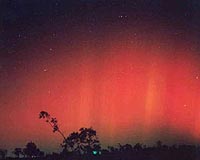
Washington DC (SPX) Oct 30, 2008 By the eerie light of a Halloween moon, while a chilly wind blows autumn-dry leaves askitter on bare and fingered branches, scary things can happen. Blood-sucking bats, creepy-crawly spiders, and a bevy of Halloween horrors give a fright on October 31. But did you know the weeks surrounding this All Hallow's Eve mark a haunting milestone? - the 5-year anniversary of some the most powerful solar storms ever recorded. Called the "Halloween Storms of 2003," these energetic storms began, surprisingly, a full two to three years after solar maximum, when solar activity was on the decline. During this usually "quiet" time, when few sunspots are visible, an outbreak of 17 major flares erupted on the sun. The flares caused the sun's magnetic field lines to stretch then suddenly snap like a rubber band stretched beyond its limit. The result was coronal mass ejections, enormous explosions on the sun's surface that can blast billions of tons of electrified gas and subatomic particles into space at speeds up to 5 million miles per hour. This 'space weather' can and does affect Earth. Space weather from these enormous solar storms slammed into Earth's magnetic field from October 19 through November 7. "The effects of these storms were ghoulish enough that [aircraft controllers] had to re-route aircraft, it affected satellite systems and communications, and it also caused a power outage in Sweden for about an hour," said Dr. Holly Gilbert, a solar scientist at NASA's Goddard Space Flight Center in Greenbelt, Md. During the height of the solar activity, more than half of the deep space and near-Earth space science missions experienced the effects of the Halloween storms of 2003. The Solar and Heliospheric Observatory (SOHO) satellite, a collaboration between NASA and the European Space Agency (ESA), failed temporarily. NASA's Advanced Composition Explorer (ACE) satellite experienced damage, and instruments aboard many spacecraft had to be shut down temporarily. Another effect of these storms was an increase in the colorful dancing lights seen at Earth's north and south poles, called aurora. "The aurora are normally limited to the higher latitudes, and these storms were so powerful they created aurora that could be seen as far south as Florida," said Gilbert. Scary solar storms like the Halloween storms of 2003 are the exception, rather than the rule. Preparing for sudden, severe space weather can help reduce the effects of storms like these. A future NASA mission, called the Solar Dynamics Observatory (SDO) will investigate the sun in great detail in an attempt to learn how changes on the sun impact Earth. The more sun-focused satellites learn about our nearest star, the better prepared we'll be the next time storms erupt on the sun. Community Email This Article Comment On This Article Share This Article With Planet Earth
Related Links Solar Dynamics Observatory Solar Science News at SpaceDaily
 CoRoT Finds Other Stars With Sun-Like Vibrations
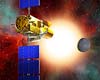 Paris, France (SPX) Oct 27, 2008
CoRoT has unambiguously detected solar-like oscillations in three main sequence stars. All three stars are of main spectral type F, with a significantly higher effective temperature than our Sun. These results are a milestone for the CNES/ESA CoRoT mission and in general for studies of stellar interiors through asteroseismology. |
|
|

| The content herein, unless otherwise known to be public domain, are Copyright 1995-2007 - SpaceDaily.AFP and UPI Wire Stories are copyright Agence France-Presse and United Press International. ESA Portal Reports are copyright European Space Agency. All NASA sourced material is public domain. Additional copyrights may apply in whole or part to other bona fide parties. Advertising does not imply endorsement,agreement or approval of any opinions, statements or information provided by SpaceDaily on any Web page published or hosted by SpaceDaily. Privacy Statement |
 del.icio.us
 Digg
Digg Reddit
 YahooMyWeb
 Google
 Facebook