|
 |
 |
 |
 |
 |
 |
 |
 |
 |

| . |  |
. |
Hayabusa Spacecraft Rounds Earth and Heads for Near-Earth Asteroid
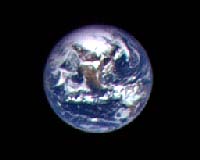
Pasadena - May 24, 2004 At 6:23 am (Greenwich time) on May 19, the Japanese Hayabusa spacecraft successfully made a close Earth approach (altitude = 3725 km), thereby gaining the velocity it needs to reach the near-Earth asteroid Itokawa, named for the father of Japanese rocketry. During the Earth swingby, the spacecraft took images of the Earth and moon to test and calibrate the on board camera called AMICA (Asteroid Multi-band Imaging Camera). These Earth and lunar images can be viewed at JAXA. Upon its arrival at the asteroid in the summer of 2005, the Hayabusa spacecraft will hover near the asteroid's surface for about four months. Its instruments will study the surface in detail, determine the asteroid's mass and bulk density and determine which minerals are present. A small coffee-can-sized surface hopper, called MINERVA, will leap about the asteroid taking surface temperature measurements and high-resolution images with each of its three miniature cameras. The spacecraft will collect up to three surface samples as its sample horn captures small pieces of the asteroid ejected when tantalum pellets are fired into its surface at 300 meters per second. With these surface samples tucked safely into the spacecraft's sample capsule, the spacecraft will return to Earth, arriving on June 10, 2007, and the sample capsule will parachute to the ground in Australia. The samples will be analyzed in various laboratories to study their detailed chemical composition and determine which meteorite examples in Earth-based collections provide the best match for Itokawa's particular composition. Hayabusa, which is Japanese for "falcon", will act much like its namesake, descending to the asteroid's surface, capturing its prey and returning it to Earth. While the scientific knowledge of near-Earth asteroids will be significantly advanced by the Hayabusa mission, the primary goals are to test four advanced technology systems: the electric propulsion (ion drive) engines; an autonomous navigation system; the sample collection system; and the sample capsule that re-enters the Earth's atmosphere. Related Links Hayabusa at JAXA Hayabusa acquired images of the earth and the moon SpaceDaily Search SpaceDaily Subscribe To SpaceDaily Express  Loneos Discovers Asteroid With The Smallest Orbit
 Flagstaff AZ (SPX) May 24, 2004
The ongoing search for near-Earth asteroids at Lowell Observatory has yielded another interesting object. Designated 2004 JG6, this asteroid was found in the course of LONEOS (the Lowell Observatory Near-Earth Object Search) on the evening of May 10 by observer Brian Skiff. |
|
|

| The content herein, unless otherwise known to be public domain, are Copyright 1995-2006 - SpaceDaily.AFP and UPI Wire Stories are copyright Agence France-Presse and United Press International. ESA PortalReports are copyright European Space Agency. All NASA sourced material is public domain. Additionalcopyrights may apply in whole or part to other bona fide parties. Advertising does not imply endorsement,agreement or approval of any opinions, statements or information provided by SpaceDaily on any Web page published or hosted by SpaceDaily. Privacy Statement |