|
 |
 |
 |
 |
 |
 |
 |
 |
 |

| . |  |
. |
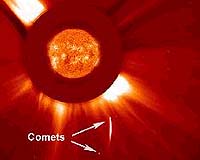
Headless Comets Survive Plunge Through Sun's Atmosphere
Greenbelt - Jun 12, 2003 A run through the jungle is too easy; for the ultimate reality show contest, try a race through the Sun's atmosphere, where two comets recently lost their heads. The tails from a pair of comets survived a close encounter with the Sun, even after the Sun's intense heat and radiation vaporized their heads (nuclei and coma), an extremely rare event photographed by the Solar and Heliospheric Observatory (SOHO) spacecraft. On May 24, 2003, a pair of comets arced in tandem towards the Sun, their paths taking them to just 0.1 solar radii above the Sun's surface, deep within the searing multimillion-degree solar atmosphere (corona). They belong to the Kreutz family of sun-grazing comets, often seen by the SOHO spacecraft while diving towards their final rendezvous with the Sun. But as in humans, twins are rare. Even more so, this pair showed another very unusual trait: What looks like a faint tail (or "puff of smoke") can be seen moving away from the Sun, seemingly emanating from a point in the orbit beyond the comet's closest approach. Normally, sungrazers simply fade and disappear at an earlier stage, obliterated by the Sun's intense heat and radiation pressure. Another pair of Kreutz sungrazers with such a "headless tail" was observed in June 1998, when the observing geometry was very similar. But out of more than 600 sungrazing comets observed during more than six years by SOHO, this is only the third showing any signs of such behavior. However, this seems now likely to confirm the existence of such comets. "Everyone who's seen this agrees it's a very interesting observation," said Dr. Douglas Biesecker, a solar researcher at the National Oceanic and Atmospheric Administration's Space Environment Center in Boulder, Colorado, and the head of SOHO's comet discovery program. SOHO has become the most prolific comet finder in history. The tail is most likely the dusty remains of the comet's nucleus, being pushed out by sunlight (radiation pressure) after all the ice in the nucleus has evaporated, thus eliminating the processes maintaining a bright coma surrounding the nucleus. Studies of the dust cloud may reveal clues to the size distribution of the dust grains. "The fact that the tail 'holds together' so well probably means that the dust is mostly the same size," said Biesecker. Comets are chunks of ice and dust that zoom around the solar system in elongated orbits. This "dirty snowball" is the nucleus of the comet; it ranges in size from a large boulder to a large city. As the comet gets close to the Sun, solar heat and light liberate gas and dust from the nucleus, forming the coma, which is an extensive, bright cloud around the nucleus, and one or more tails. A comet's dust tail can be millions of miles (kilometers) long and is pushed away from the Sun by sunlight. Comets also have a tail of electrically charged particles (ions) that is usually fainter and is pushed away from the Sun by the solar wind, a thin stream of electrified gas that blows constantly from the Sun. Both tails point away from the Sun, even for comets that are traveling back outwards in the solar system. Studies of the tails can reveal changes in solar wind structure and radiance of the Sun. Related Links More Pixs More Pixs Search SpaceDaily Subscribe To SpaceDaily Express  Rosetta Retasked For 10 Year Journey
 Sacramento - Jun 11, 2003
The European Space Agency's ambitious Rosetta mission to rendezvous with and orbit a comet nucleus for the first time -- and then dispatch a small lander onto its surface -- has just survived the most bizarre crisis imaginable. |
|
|

| The content herein, unless otherwise known to be public domain, are Copyright 1995-2006 - SpaceDaily.AFP and UPI Wire Stories are copyright Agence France-Presse and United Press International. ESA PortalReports are copyright European Space Agency. All NASA sourced material is public domain. Additionalcopyrights may apply in whole or part to other bona fide parties. Advertising does not imply endorsement,agreement or approval of any opinions, statements or information provided by SpaceDaily on any Web page published or hosted by SpaceDaily. Privacy Statement |