
. Military Space News .
Hearts Of Galaxies Close In For Cosmic Train Wreck

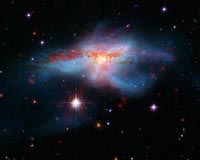
This image of a pair of colliding galaxies called NGC 6240 shows them in a rare, short-lived phase of their evolution just before they merge into a single, larger galaxy. The prolonged, violent collision has drastically altered the appearance of both galaxies and created huge amounts of heat - turning NGC 6240 into an "infrared luminous" active galaxy. A rich variety of active galaxies, with different shapes, luminosities and radiation profiles exist.

These galaxies may be related - astronomers have suspected that they may represent an evolutionary sequence. By catching different galaxies in different stages of merging, a story emerges as one type of active galaxy changes into another. NGC 6240 provides an important "missing link" in this process. Image credit: NASA/JPL-Caltech/STScI-ESA. For a larger version of this iamge please go here.

by Staff Writers
Pasadena CA (SPX) Mar 18, 2009
A new image from NASA's Spitzer Space Telescope offers a rare view of an imminent collision between the cores of two merging galaxies, each powered by a black hole with millions of times the mass of the sun.

The galactic cores are in a single, tangled galaxy called NGC 6240, located 400-million light years away in the constellation Ophiuchus. Millions of years ago, each core was the dense center of its own galaxy before the two galaxies collided and ripped each other apart.

Now, these cores are approaching each other at tremendous speeds and preparing for the final cataclysmic collision. They will crash into each other in a few million years, a relatively short period on a galactic timescale.

The spectacular image combines visible light from NASA's Hubble Space Telescope and infrared light from Spitzer. It catches the two galaxies during a rare, short-lived phase of their evolution, when both cores of the interacting galaxies are still visible but closing in on each other fast.

"One of the most exciting things about the image is that this object is unique," said Stephanie Bush of the Harvard-Smithsonian Center for Astrophysics, Cambridge, Mass., lead author of a new paper describing the observation in an upcoming issue of the Astrophysical Journal.

"Merging is a quick process, especially when you get to the train wreck that is happening. There just aren't many galactic mergers at this stage in the nearby universe."

NGC 6240 is already putting out huge amounts of infrared light, an indication that a burst of star formation is underway. The extra infrared radiation is common in interacting galaxies; as the two galaxies interact, dust and gas swept up by the collision form a burst of new stars that give off infrared light.

Such galaxies are called luminous infrared galaxies. Spitzer's infrared array camera can image the extra heat from newly formed stars, even though their visible light is obscured by thick dust clouds around them.

The blob-like shape of the galaxy is due to the sustained violence of the collision. Streams of millions of stars are being ripped off the galaxy, forming wispy "tidal tails" that lead off NGC 6240 in several directions. But things are about to get even more violent as the main event approaches and the two galactic cores meld into one.

In the center of NGC 6240, the two black holes in the cores will whip up a frenzy of radiation as they careen towards one another head-on, likely transforming the galaxy into a monster known as an ultra-luminous infrared galaxy, thousands of times as bright in infrared as our Milky Way.

Another fascinating aspect of this rare object is that no two galactic mergers are the same.

"Not only are there few objects at this stage, but each object is unique because it came from different progenitor galaxies," said Bush. "These observations give us another layer of information about this galaxy, and galactic mergers in general."

Infrared light taken by Spitzer's infrared array camera at 3.6 and 8.8 microns (red) shows cold dust and radiation from star formation; visible light from Hubble (green and blue) shows hot gas and stars.

Other authors of this paper include Zhong Wang, Margarita Karovska and Giovanni Fazio, all of the Harvard-Smithsonian Center for Astrophysics.

Share This Article With Planet Earth
del.icio.usdel.icio.us DiggDigg RedditReddit
YahooMyWebYahooMyWeb GoogleGoogle FacebookFacebook


Related Links
Spitzer
Stellar Chemistry, The Universe And All Within It


Memory Foam Mattress Review
Newsletters :: SpaceDaily :: SpaceWar :: TerraDaily :: Energy Daily
XML Feeds :: Space News :: Earth News :: War News :: Solar Energy News


Galactic Dust Bunnies Found To Contain Carbon After All
Pasadena CA (SPX) Mar 17, 2009
Using NASA's Spitzer Space Telescope, researchers have found evidence suggesting that stars rich in carbon complex molecules may form at the center of our Milky Way galaxy.


  • No Japan-China summit this month: officials
  • Sarkozy wins confidence vote on return to NATO command
  • Pentagon mocks Russian military moves in Latin America
  • China navy criticises dispatch of US destroyers: state media

  • China voices concern over Korean peninsula
  • Analysis: North Korean threat to Japan
  • Britain offers Iran 'clear choice' on nuclear power
  • NKorea's Kim says regime 'invulnerable'

  • NKorea missile threat may be negotiating tactic: Lee
  • US to urge Russia not to sell missiles to Iran: Clinton
  • NKorean satellite launch would trigger UN sanctions: Aso
  • NKorea assembling rocket ahead of planned launch: report

  • Obama faces shoot-down dilemma with NKorea launch
  • Czech PM defers ratification of US missile shield
  • The Qassam BMD Fiasco Part Two
  • Military Bureaucrats Out Phalanx Barak Part Three

  • Cathay Pacific lost 1.1 billion dollars in 2008
  • National hypersonic science centers named
  • First China-assembled Airbus set for June delivery: report
  • China's large passenger jet ready in eight years: report

  • US says it shot down Iranian drone north of Baghdad
  • Pakistan complains of 'alienation' from US drone strikes
  • USAF MQ-1 Predators Achieve 500,000 Flight Hours
  • Boeing Insitu ScanEagle UAS Completes Sea Trials With Singapore Navy

  • Safer Iraqi cities as troops withdraw: US commander
  • Iraq/Afghan War News: Iraq to get Abrams
  • Dogs of War: Blue on white
  • After Iraq, more US caution on preemptive attacks: Gates

  • Why The F-22 Is Vital Part Three
  • Thompson Files: A copter for Obama
  • Russian air force withdraws 90 faulty MiGs: report
  • Why The F-22 Is Vital Part One

  • The content herein, unless otherwise known to be public domain, are Copyright 1995-2007 - SpaceDaily.AFP and UPI Wire Stories are copyright Agence France-Presse and United Press International. ESA Portal Reports are copyright European Space Agency. All NASA sourced material is public domain. Additional copyrights may apply in whole or part to other bona fide parties. Advertising does not imply endorsement,agreement or approval of any opinions, statements or information provided by SpaceDaily on any Web page published or hosted by SpaceDaily. Privacy Statement