
 |
 |
 |
 |
 |
 |
 |
 |
 |
 |

| . |  |
. |

Kathmandu, Nepal (UPI) Oct 5, 2010 More regional and bilateral cooperation is needed to tackle climate change in the Himalayas, an Indian official said. "The behavior of Himalayan glaciers is fundamentally different from that of glaciers in the polar regions and they need special investigation and analysis," Indian Minister for Environment and Forests Shri Jairam Ramesh said Monday, The Himalayan Times reports. "Biodiversity does not stop at geographical boundaries and countries have no choice but to work together for protection and management and also to support adaptation," he said. Solid scientific information is necessary to provide a basis for political decision making and improving governance, Ramesh told some 250 participants from 24 countries attending a Himalayan region climate change symposium organized by the International Center for Integrated Mountain Development in Kathmandu. To address that need, the U.S. National Aeronautics and Space Administration and the U.S. Agency for International Development during the conference Tuesday launched a Web-based environmental management system that allows scientists, governments and aid agencies to access satellite images of the Himalayas. Designed to address critical issues such as land cover change, air quality, glacial melt and adaptation to climate change, SERVIR-Himalaya will integrate Earth science data from NASA satellites with geospatial information products from other U.S. government agencies. "NASA's science mission begins here on Earth, with greater awareness and understanding of our changing planet, and solutions for protecting our environment, resources and human lives," said NASA Administrator Charles Bolden in a news release. Some 1.3 billion people rely on water that flows from Himalayan glaciers. Earlier this year the United Nation's Intergovernmental Panel on Climate Change announced it had made a mistake in saying the Himalayan glaciers may disappear by 2035 due to climate change. IPCC clarified, however, that while the projected year was in error, the glaciers are indeed melting away. Madan Shrestha of the Nepal Academy of Science and Technology, who has been studying the glaciers since 1974, told the Inter Press Service news agency, "We have ample scientific evidence to prove that climate change is causing the Himalayan glaciers to retreat." Dawa Sherpa, climate ambassador for the World Wildlife Fund, told IPS that the devastation of climate change is already evident on Mount Everest in the Himalayas. "Snow cover in the mountains is decreasing, crevasses are opening up in the glaciers," said Dawa, who has twice scaled Everest, the world's highest peak. "Avalanches (have been) occurring frequently (in) the past two years." Puddles of water, he said, have even been observed at altitudes of 26,000 feet on Mount Everest.
Share This Article With Planet Earth
Related Links Beyond the Ice Age

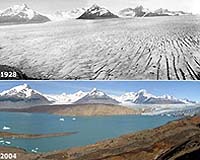 Argentine Congress votes to restrict mining near glaciers
Buenos Aires (AFP) Sept 30, 2010 Argentina's Congress passed a law early Thursday that seeks to protect environmentally sensitive glaciers by imposing strict limits on mining, potentially affecting foreign investments. The measure, approved in the Senate by a vote of 35 to 33 with one abstention, prohibits mining near glaciers along Argentina's 5,000 kilometer (3,100 mile) border with Chile. The senate also rejected a l ... read more |
|
|
| The content herein, unless otherwise known to be public domain, are Copyright 1995-2010 - SpaceDaily. AFP and UPI Wire Stories are copyright Agence France-Presse and United Press International. ESA Portal Reports are copyright European Space Agency. All NASA sourced material is public domain. Additional copyrights may apply in whole or part to other bona fide parties. Advertising does not imply endorsement,agreement or approval of any opinions, statements or information provided by SpaceDaily on any Web page published or hosted by SpaceDaily. Privacy Statement |


 del.icio.us
 Digg
Digg Reddit
 YahooMyWeb
 Google
 Facebook


