|
 |
 |
 |
 |
 |
 |
 |

| . |  |
. |

|
|
. |

 by Staff Writers Los Angeles CA (SPX) Aug 17, 2011
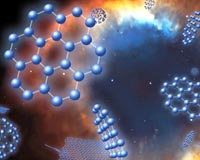
NASA's Spitzer Space Telescope has spotted the signature of flat carbon flakes, called graphene, in space. If confirmed, this would be the first-ever cosmic detection of the material - which is arranged like chicken wire in flat sheets that are one atom thick. Graphene was first synthesized in a lab in 2004, and subsequent research on its unique properties garnered the Nobel Prize in 2010. It's as strong as it is thin, and conducts electricity as well as copper. Some think it's the "material of the future," with applications in computers, screens on electrical devices, solar panels and more. Graphene in space isn't going to result in any super-fast computers, but researchers are interested in learning more about how it is created. Understanding chemical reactions involving carbon in space may hold clues to how our own carbon-based selves and other life on Earth developed. Spitzer identified signs of the graphene in two small galaxies outside of our own, called the Magellanic Clouds, specifically in the material shed by dying stars, called planetary nebulae. The infrared-sensing telescope also spotted a related molecule, called C70, in the same region - marking the first detection of this chemical outside our galaxy. C70 and graphene belong to the fullerene family, which includes molecules called "buckyballs," or C60. These carbon spheres contain 60 carbon atoms arranged like a soccer ball, and were named after their resemblance to the architectural domes of Buckminister Fuller. C70 molecules contain 70 carbon atoms and are longer in shape, more like a rugby ball. Fullerenes have been found in meteorites carrying extraterrestrial gases, and water has been very recently encapsulated in buckyballs by using new laboratory techniques. These findings suggest fullerenes may have helped transport materials from space to Earth long ago, possibly helping to kick-start life. Spitzer definitively detected both buckyballs and C70 in space for the first time in July 2010. It later spotted buckyballs - equivalent in mass to 15 full moons - in the Small Magellanic Cloud. These latter results demonstrated that, contrary to what was previously believed, fullerenes and other complex molecules could form in hydrogen-rich environments. According to astronomers, the graphene, buckyballs and C70 might be forming when shock waves generated by dying stars break apart hydrogen-containing carbon grains. The team that performed the Spitzer research is led by Domingo Anibal Garcia-Hernandez of the Instituto de Astrofisica de Canarias in Spain. The results appear in the Astrophyscial Journal Letters. Garcia-Hernandez is also the lead author of the study that used Spitzer to detect heaps of buckyballs in the Small Magellanic Cloud.
|
. |
|
| The content herein, unless otherwise known to be public domain, are Copyright 1995-2011 - Space Media Network. AFP and UPI Wire Stories are copyright Agence France-Presse and United Press International. ESA Portal Reports are copyright European Space Agency. All NASA sourced material is public domain. Additional copyrights may apply in whole or part to other bona fide parties. Advertising does not imply endorsement,agreement or approval of any opinions, statements or information provided by Space Media Network on any Web page published or hosted by Space Media Network. Privacy Statement |

 del.icio.us
 Digg
Digg Reddit
 Google