|
 |
 |
 |
 |
 |
 |
 |

| . |  |
. |

|
|
. |

 by Michael Elser Zurich, Switzerland (SPX) Sep 20, 2011
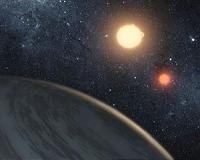
Earth's Moon might have played an important role in the development and evolution of life on Earth. The Moon was formed via a giant impact in which a Mars-size projectile collided with the young Earth. The ejected material accumulated in orbit around our planet and formed the Moon. After its formation, the Moon was much closer to Earth than it is today, which caused high tides several times per day. This may have helped promote the very early evolution of life. In addition, a stable climate of more than a billion years may be essential to guarantee a suitable environment for life. But without its satellite, Earth would suffer chaotic variations of the direction of its spin axis, which would in turn result in dramatic variations of the climate. Therefore, concerning the habitability of extrasolar planets, it is reasonable to ask: How common are Earth-Moon planetary systems? Sebastian Elser, Prof. Ben Moore and Dr. Joachim Stadel of the University of Zurich, Switzerland, along with Ryuji Morishima of NASA's Jet Propulsion Laboratory in Pasadena, California, ran a large set of N-body simulations to study the formation of the rocky planets in our solar system via the collisional growth of thousands of small rocky bodies in a disk around the Sun. They identified numerous satellite-forming collisions during this process and estimated the masses of the generated companions. Moreover, they took into account the orbital evolution of the satellites, since tidal forces change the spin and orbit of a satellite and can cause it to be lost within a few thousand years in the most extreme cases. Finally, they studied the subsequent collision history, since giant impacts after the epoch of satellite formation may pose a challenge to the survival of a satellite. They find that Earth-Moon planetary systems occur relatively frequently, with more than 1 in 12 terrestrial planets hosting a massive moon. Uncertainties in the study result in a range of 1 in 4 to 1 in 45. Further work and more N-body simulations are needed to obtain more precise results. Related Links Physics at University of Zurich Extreme Solar Systems II website Lands Beyond Beyond - extra solar planets - news and science Life Beyond Earth
|
. |
|
| The content herein, unless otherwise known to be public domain, are Copyright 1995-2011 - Space Media Network. AFP and UPI Wire Stories are copyright Agence France-Presse and United Press International. ESA Portal Reports are copyright European Space Agency. All NASA sourced material is public domain. Additional copyrights may apply in whole or part to other bona fide parties. Advertising does not imply endorsement,agreement or approval of any opinions, statements or information provided by Space Media Network on any Web page published or hosted by Space Media Network. Privacy Statement |

 del.icio.us
 Digg
Digg Reddit
 Google