
 |
 |
 |
 |
 |
 |
 |
 |
 |
 |

| . |  |
. |

Pasadena CA (JPL) Nov 17, 2010 There are several major meteor showers to enjoy every year at various times, with some more active than others. For example, April's Lyrids are expected to produce about 15 meteors an hour at their peak for observers viewing in good conditions. Now, if you put the same observer in the same good conditions during a higher-rate shower like August's Perseids or December's Geminids, that person could witness up to 80 meteors an hour during peak activity. The 2010 Leonid meteor shower peaks the evening of Wednesday, Nov. 17. While the annual shower has been spectacular in the past, this year's half-full moon will obstruct viewing for most backyard astronomers. If you're viewing in dark conditions, the best viewing time will be after midnight, in the hours just before dawn. At most, expect to see approximately 15 meteors per hour. Whether you're watching from a downtown area or the dark countryside, here are some tips to help you enjoy these celestial shows of shooting stars. Those streaks of light are really caused by tiny specks of comet-stuff hitting Earth's atmosphere at very high speed and disintegrating in flashes of light. First a word about the moon - it is not the meteor watcher's friend. Light reflecting off a bright moon can be just as detrimental to good meteor viewing as those bright lights of the big city. There is nothing you can do except howl at the moon, so you'll have to put up with it or wait until the next favorable shower. However, even though the 2010 Perseids and Geminids share the night sky with the moon, they are still expected to produce more visible meteor activity than other major showers that don't have an interfering moon. The best thing you can do to maximize the number of meteors you'll see is to get as far away from urban light pollution as possible and find a location with a clear, unclouded view of the night sky. If you enjoy camping, try planning a trip that coincides with dates of one of the meteor showers listed below. Once you get to your viewing location, search for the darkest patch of sky you can find, as meteors can appear anywhere overhead. The meteors will always travel in a path away from the constellation for which the shower is named. This apparent point of origin is called the "radiant." For example, meteors during a Leonid meteor shower will appear to originate from the constellation Leo. Whether viewing from your front porch or a mountaintop, be sure to dress for success. This means clothing appropriate for cold overnight temperatures, which might include mittens or gloves, and blankets. This will enable you to settle in without having to abandon the meteor-watching because your fingers are starting to turn colors. Next, bring something comfortable on which to sit or lie down. While Mother Nature can put on a magnificent celestial display, meteor showers rarely approach anything on the scale of a July 4th fireworks show. Plan to be patient and watch for at least half an hour. A reclining chair or ground pad will make it far more comfortable to keep your gaze on the night sky. Lastly, put away the telescope or binoculars. Using either reduces the amount of sky you can see at one time, lowering the odds that you'll see anything but darkness. Instead, let your eyes hang loose and don't look in any one specific spot. Relaxed eyes will quickly zone in on any movement up above, and you'll be able to spot more meteors. Avoid looking at your cell phone or any other light. Both destroy night vision. If you have to look at something on Earth, use a red light. Some flashlights have handy interchangeable filters. If you don't have one of those, you can always paint the clear filter with red fingernail polish. The meteor showers listed below will provide casual meteor observers with the most bang for their buck. They are the easiest to observe and most active. All these showers are best enjoyed in the hours after midnight. Be sure to also check the "Related Links" box for additional information, and for tools to help you determine how many meteors may be visible from your part of the world.
Share This Article With Planet Earth
Related Links - Asteroid and Comet Impact Danger To Earth - News and Science

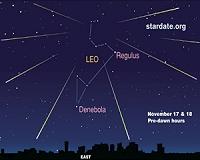 Leonid Meteor Shower Peaks Wednesday November 17
Austin TX (SPX) Nov 15, 2010 The Leonid meteor shower best viewing this year will be in the two to three hours before dawn on November 17 and 18, according to the editors of StarDate magazine. There is always some uncertainty in the number of meteors the Leonid shower will produce, but viewers should expect to see at least 20 meteors per hour if they have clear skies. The nearly full Moon will set several hours before ... read more |
|
|
| The content herein, unless otherwise known to be public domain, are Copyright 1995-2010 - SpaceDaily. AFP and UPI Wire Stories are copyright Agence France-Presse and United Press International. ESA Portal Reports are copyright European Space Agency. All NASA sourced material is public domain. Additional copyrights may apply in whole or part to other bona fide parties. Advertising does not imply endorsement,agreement or approval of any opinions, statements or information provided by SpaceDaily on any Web page published or hosted by SpaceDaily. Privacy Statement |


 del.icio.us
 Digg
Digg Reddit
 YahooMyWeb
 Google
 Facebook


