|
 |
 |
 |
 |
 |
 |
 |
 |
 |

| . |  |
. |
 by Staff Writers Notre Dame IN (SPX) Jan 25, 2016
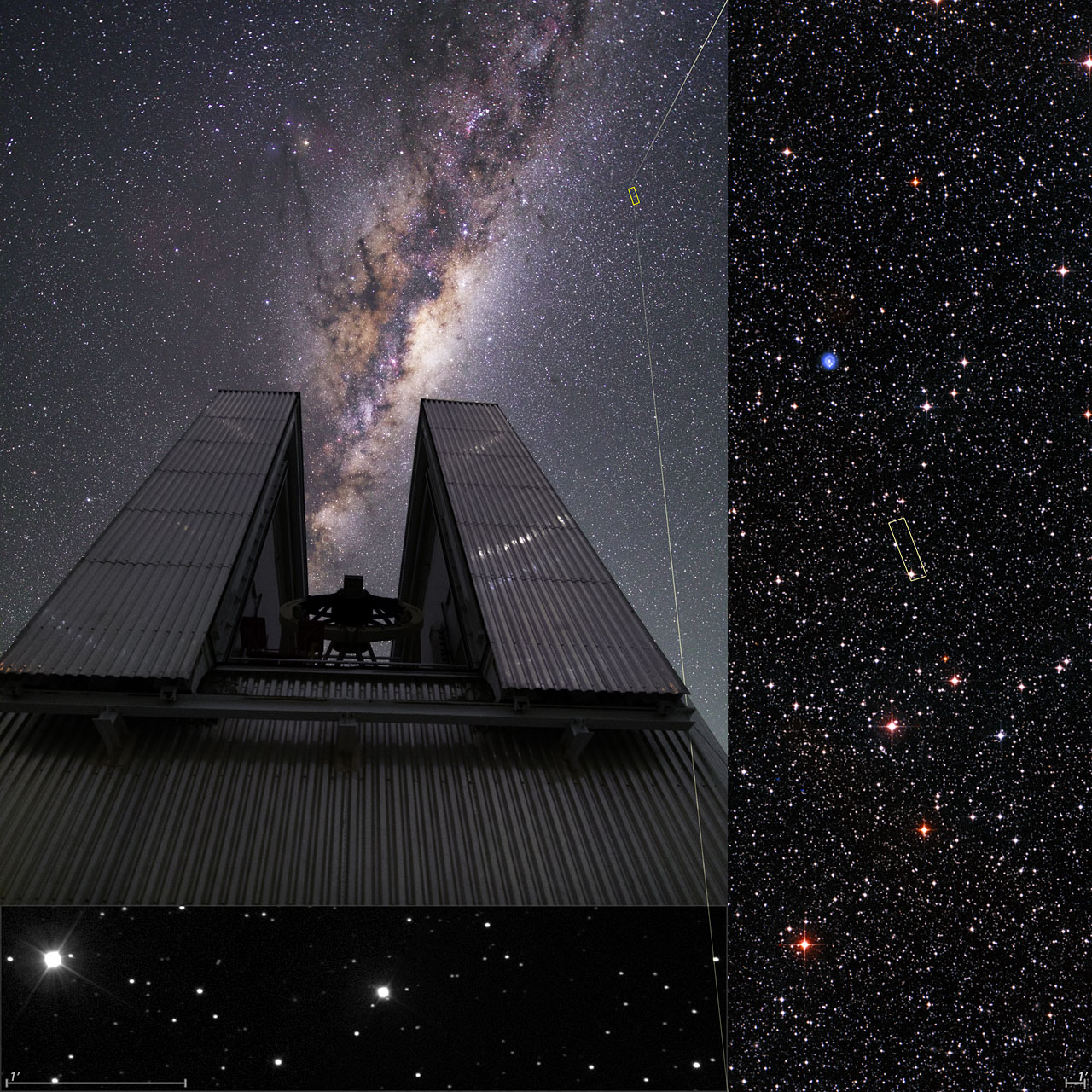
A team of researchers has observed the brightest ultra metal-poor star ever discovered. The star is a rare relic from the Milky Way's formative years. As such, it offers astronomers a precious opportunity to explore the origin of the first stars that sprung to life within our galaxy and the universe. A Brazilian-American team including Vinicius Placco, a research assistant professor at the University of Notre Dame and a member of JINA-CEE (Joint Institute for Nuclear Astrophysics - Center for the Evolution of the Elements), and led by Jorge Melendez from the University of Sao Paulo used two of European Southern Observatory's telescopes in Chile to discover this star, named 2MASS J18082002-5104378. The star was spotted in 2014 using ESO's New Technology Telescope. Follow-up observations using ESO's Very Large Telescope discovered that, unlike younger stars such as the sun, this star shows an unusually low abundance of what astronomers call metals - elements heavier than hydrogen and helium. It is so devoid of these elements that it is known as an ultra metal-poor star. Although thought to be ubiquitous in the early universe, metal-poor stars are now a rare sight within both the Milky Way and other nearby galaxies. Metals are formed during nuclear fusion within stars, and are spread throughout the interstellar medium when some of these stars grow old and explode. Subsequent generations of stars therefore form from increasingly metal-rich material. Metal-poor stars, however, formed from the unpolluted environment that existed shortly after the Big Bang. Exploring stars such as 2MASS J18082002-5104378 may unlock secrets about their formation, and show what the universe was like at its very beginning. The results have been published in Astronomy and Astrophysics. In addition to Placco and Melendez, the team consisted of Marcelo Tucci-Maia, Universidade de Sao Paulo, IAG, Brazil; Ivan Ramirez, University of Texas at Austin, McDonald Observatory and Department of Astronomy; Ting S. Li, Texas Aa and M University, Department of Physics and Astronomy; and Gabriel Perez, Universidade de Sao Paulo, IAG, Brazil.
Related Links University of Notre Dame Stellar Chemistry, The Universe And All Within It
|
|||||||||||||
|
|
| The content herein, unless otherwise known to be public domain, are Copyright 1995-2024 - Space Media Network. All websites are published in Australia and are solely subject to Australian law and governed by Fair Use principals for news reporting and research purposes. AFP, UPI and IANS news wire stories are copyright Agence France-Presse, United Press International and Indo-Asia News Service. ESA news reports are copyright European Space Agency. All NASA sourced material is public domain. Additional copyrights may apply in whole or part to other bona fide parties. All articles labeled "by Staff Writers" include reports supplied to Space Media Network by industry news wires, PR agencies, corporate press officers and the like. Such articles are individually curated and edited by Space Media Network staff on the basis of the report's information value to our industry and professional readership. Advertising does not imply endorsement, agreement or approval of any opinions, statements or information provided by Space Media Network on any Web page published or hosted by Space Media Network. General Data Protection Regulation (GDPR) Statement Our advertisers use various cookies and the like to deliver the best ad banner available at one time. All network advertising suppliers have GDPR policies (Legitimate Interest) that conform with EU regulations for data collection. By using our websites you consent to cookie based advertising. If you do not agree with this then you must stop using the websites from May 25, 2018. Privacy Statement. Additional information can be found here at About Us. |


 del.icio.us
 Digg
Digg Reddit
 Google