|
 |
 |
 |
 |
 |
 |
 |
 |
 |

| . |  |
. |
Hubble Makes Movie Of Neptune's Dynamic Atmosphere
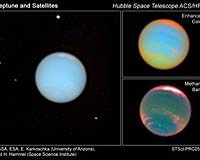
Tucson AZ (SPX) Sep 02, 2005 New NASA Hubble Space Telescope images of the distant planet Neptune show a dynamic atmosphere and capture the fleeting orbits of its satellites. The images have been assembled into a time-lapse movie revealing the orbital motion of the satellites. Images were taken in 14 different colored filters probing various altitudes in Neptune's deep atmosphere so that scientists can study the haze and clouds in detail. These are several snapshots from the Neptune movie. The natural-color view of Neptune (to left), common to naked eye telescopic views by amateur astronomers, reveals a cyan colored planet. Methane gas in Neptune's atmosphere absorbs most of the red sunlight hitting the planet, making it look blue-green. The image was created by combining images in red, green, and blue light. Neptune's subtle features are more visible in the enhanced-color view (top right). Images taken in special methane filters show details not visible to the human eye (bottom right). The features seen in this enhanced image must be above most of the sunlight-absorbing methane to be detectable through these special filters. Neptune is the most distant giant planet in our Solar System, orbiting the Sun every 165 years. It is so large tht nearly 60 Earths could fit inside it. A day on Neptune is between 14 hours and 19 hours. The inner two thirds of Neptune is composed of a mixture of molten rock, water, liquid ammonia and methane. The outer third is a mixture of heated gases comprised of hydrogen, helium, water and methane. On April 29 and 30, 2005, Hubble images were taken every 4-5 hours, spaced at about a quarter of Neptune's rotational period. These where combined to create a time-lapse movie of the dynamic planet. Related Links SpaceDaily Search SpaceDaily Subscribe To SpaceDaily Express  Gemini Samples Spectrum Of 2003 UB313: Pluto-Like Surface
 Washington DC (SPX) Jul 31, 2005
The Gemini Observatory has obtained a preliminary spectrum of 2003 UB313, the lastest so-called "10th planet". These observations were obtained on January 25, 2005 by Chad Trujillo, a Gemini staff member who is also on the discovery team for 2003 UB313, the existence of which was formally announced by the Minor Planet Center in Cambridge, MA on July 29, 2005.
--------------------------------------------------------- It's new. And it's downright terrific! Celestron's CPC Schmidt-Cassegrain telescope is the scope you've been waiting for! It offers new alignment technology, advanced engineering, and bold new design at a new, low price! In fact, Celestron's Professional Computerized (CPC) scope with revolutionary SkyAlign Alignment Technology redefines everything that amateur astronomers are looking for. It offers quick and simple alignment, GPS technology, unsurpassed optical quality, ease of use, advanced ergonomics, enhanced computerization and, most important, affordability. Want to view M-31 tonight? One button takes you there!
Shop for telescopes online at Telescopes.com! today!
|
|
|

| The content herein, unless otherwise known to be public domain, are Copyright 1995-2006 - SpaceDaily.AFP and UPI Wire Stories are copyright Agence France-Presse and United Press International. ESA PortalReports are copyright European Space Agency. All NASA sourced material is public domain. Additionalcopyrights may apply in whole or part to other bona fide parties. Advertising does not imply endorsement,agreement or approval of any opinions, statements or information provided by SpaceDaily on any Web page published or hosted by SpaceDaily. Privacy Statement |