
 |
 |
 |
 |
 |
 |
 |
 |
 |
 |

| . |  |
. |

Paris, France (ESA) Jul 15, 2010 Strangely shaped dust clouds, resembling spilled liquids, are silhouetted against a colourful background of glowing gas in this newly released Hubble image. The star-forming region NGC 2467 is a vast cloud of gas - mostly hydrogen - that serves as an incubator for new stars. Some of these youthful stars have emerged from the dense clouds where they were born and now shine brightly, hot and blue in this picture, but many others remain hidden. The full beauty of this object and hints of the astrophysical processes at work within it are revealed in this super-sharp image from Hubble. Hot young stars that recently formed from the cloud are emitting fierce ultraviolet radiation that is causing the whole scene to glow while also sculpting the environment and gradually eroding the gas clouds. Studies have shown that most of the radiation comes from the single hot and brilliant massive star just above the centre of the image. Its fierce radiation has cleared the surrounding region and some of the next generation of stars are forming in the denser regions around the edge. One of the most familiar star-forming regions is the Orion Nebula, which can be seen with the naked eye. NGC 2467 is a similar but more distant example. Such stellar nurseries can be seen out to considerable distances in the Universe, and their study is important in determining the distance and chemical composition of other galaxies. Some galaxies contain huge star-forming regions, which may contain tens of thousands of stars. Another dramatic example is the 30 Doradus region in the Large Magellanic Cloud. NGC 2467 was discovered in the nineteenth century and lies in the southern constellation of Puppis, which represents the poop deck of Jason's fabled ship Argo from Greek mythology. NGC 2467 is thought to lie about 13 000 light-years from Earth. The picture was created from images taken with the Wide Field Channel of the Advanced Camera for Surveys through three different filters (F550M, F660N and F658N, shown in blue, green and red respectively). These data were taken in 2004.
Share This Article With Planet Earth
Related Links ESA/Hubble Information Centre Space Telescope News and Technology at Skynightly.com

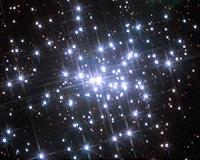 Hubble Catches Stars On The Move
Heidelberg, Germany (SPX) Jun 03, 2010 By exploiting the exquisite image quality of the NASA/ESA Hubble Space Telescope and comparing two observations made ten years apart astronomers have, for the first time, managed to measure the tiny motions of several hundred young stars within the central cluster of the star-forming region NGC 3603. The team was surprised to find that the stars are moving in ways that are at odds with the ... read more |
|
|
| The content herein, unless otherwise known to be public domain, are Copyright 1995-2010 - SpaceDaily. AFP and UPI Wire Stories are copyright Agence France-Presse and United Press International. ESA Portal Reports are copyright European Space Agency. All NASA sourced material is public domain. Additional copyrights may apply in whole or part to other bona fide parties. Advertising does not imply endorsement,agreement or approval of any opinions, statements or information provided by SpaceDaily on any Web page published or hosted by SpaceDaily. Privacy Statement |


 del.icio.us
 Digg
Digg Reddit
 YahooMyWeb
 Google
 Facebook


