|
 |
 |
 |
 |
 |
 |
 |
 |
 |

| . |  |
. |
Hubble Takes Sharpest Shot Yet Of New Red Spot On Jupiter
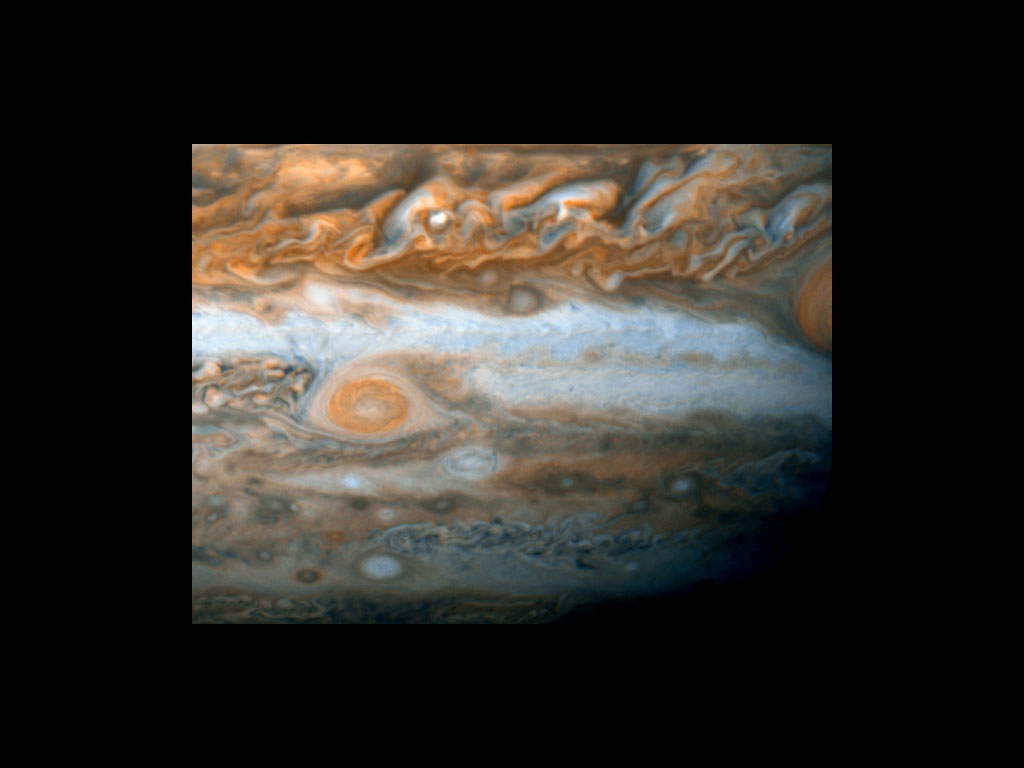
Berkeley CA (SPX) May 05, 2006 NASA's Hubble Space Telescope has given astronomers their most detailed look yet of a second red spot emerging on Jupiter. For the first time in history, astronomers have witnessed the birth of a new red spot on the giant planet. The storm is roughly one-half the diameter of its bigger and legendary cousin, the Great Red Spot, and researchers think the new spot might be related to possible major climate change in Jupiter's atmosphere. Called "Red Spot Jr." by some astronomers, who have been following the new feature for the past few months, Hubble's images provide a level of detail comparable to that achieved by NASA's Voyager 1 and 2 spacecraft as they flew by Jupiter in the early 1980s. Before it mysteriously changed to the same color as the Great Red Spot, the smaller spot was known as the White Oval BA. It formed after three white oval-shaped storms merged during 1998 to 2000. At least one or two of the progenitor white ovals can be traced back to 90 years ago, but they may have been present earlier. A third spot appeared in 1939. The Great Red Spot itself has been visible for the past 400 years - as long as earthbound observers have seen it through telescopes. When viewed at near-infrared wavelengths - specifically 892 nanometers, the absorption band of methane gas - Red Spot Jr. is about as prominent on Jupiter as the Great Red Spot. This could mean the storm rises miles above the top of the main cloud deck on Jupiter, just as its larger cousin is thought to do. Some astronomers think the red hue could be produced as the spots dredge up material from deeper in the gas-giant planet's atmosphere, which is then chemically altered by the Sun's ultraviolet radiation. The Hubble images also suggest Jupiter might be in the midst of a global climate change that will alter its average temperature at some latitudes by as much as 10 degrees Fahrenheit. The transfer of heat from the equator to the planet's south pole is predicted to nearly shut off at 34 degrees southern latitude, the latitude where the second red spot is forming. Philip Marcus, of the University of California, Berkeley, predicted the shut-off would become apparent approximately seven years after the White Oval collisions in 1998 to 2000. Related Links Red Spot Images At Hubble Hubble  Hitting Europa Hard Could Have A Real Impact
 Moffett Field CA (SPX) May 03, 2006
Jupiter's moon Europa is one of the most intriguing places in the solar system to Astrobiologists. An icy shell overlies a deep water ocean, and tidal flexing from Jupiter's gravity may provide energy for life. |
|
|

| The content herein, unless otherwise known to be public domain, are Copyright 1995-2006 - SpaceDaily.AFP and UPI Wire Stories are copyright Agence France-Presse and United Press International. ESA PortalReports are copyright European Space Agency. All NASA sourced material is public domain. Additionalcopyrights may apply in whole or part to other bona fide parties. Advertising does not imply endorsement,agreement or approval of any opinions, statements or information provided by SpaceDaily on any Web page published or hosted by SpaceDaily. Privacy Statement |