|
|
|
|
|
|
|
|
|
|
|


| . |  |
. |
|
|
|
 by Staff Writers Munich, Germany (SPX) Jun 04, 2014
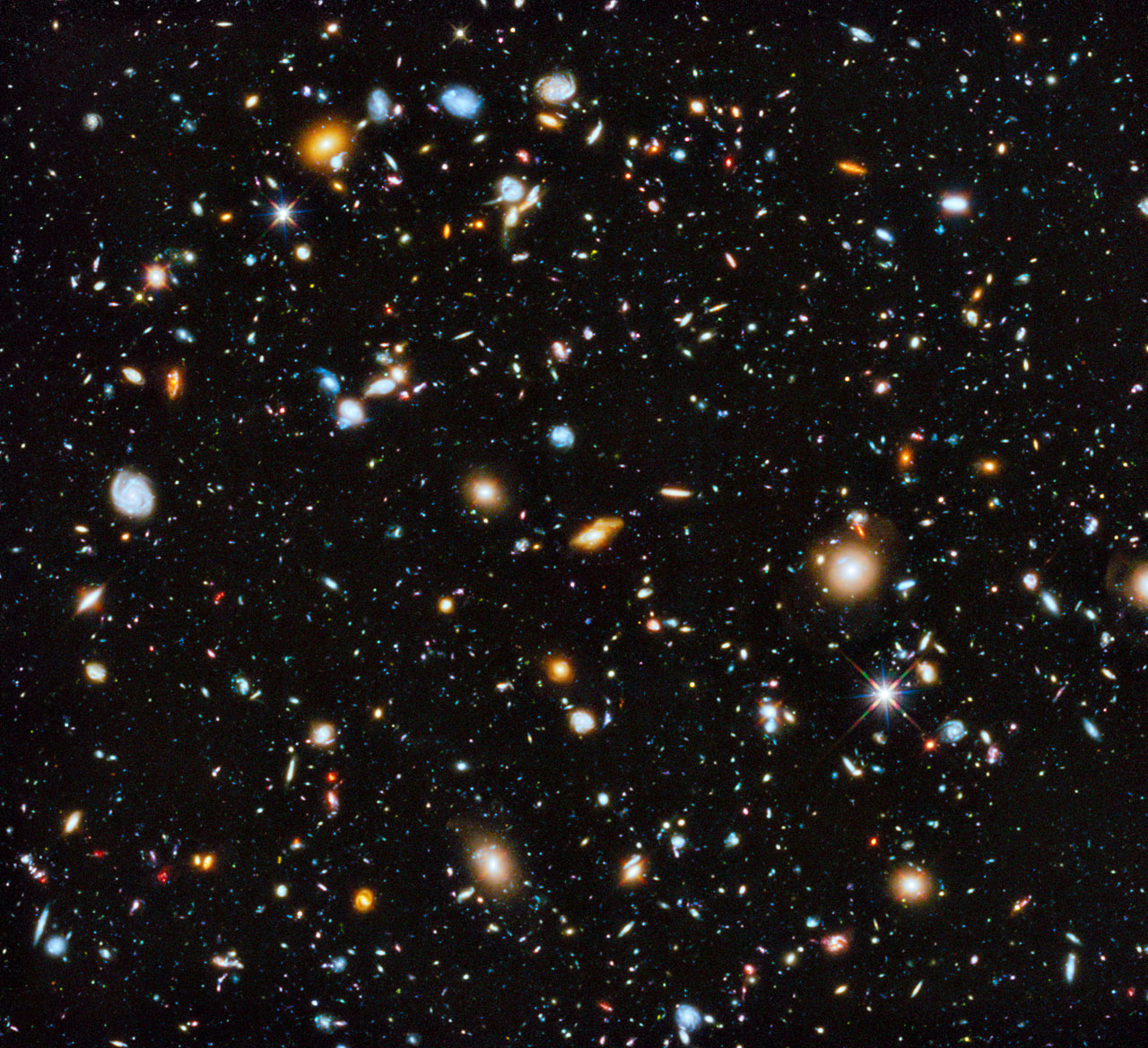
Astronomers using the Hubble Space Telescope have captured the most comprehensive picture ever assembled of the evolving Universe - and one of the most colourful. The study is called the Ultraviolet Coverage of the Hubble Ultra Deep Field (UVUDF) project. Prior to this survey, astronomers were in a curious position. They knew a lot about star formation occurring in nearby galaxies thanks to UV telescope facilities such as NASA's Galex observatory, which operated from 2003 to 2013. And, thanks to Hubble's near-infrared and visible capability, they had also studied star birth in the most distant galaxies. We see these distant galaxies in their most primitive stages due to the vast amount of time it takes their light to reach us. However, between 5 and 10 billion light-years away from us - corresponding to a time period when most of the stars in the Universe were born - there was a lack of the data needed to fully understand star formation. The hottest, most massive and youngest stars, which emit light in the ultraviolet, were often neglected as subjects of direct observation, leaving a significant gap in our knowledge of the cosmic timeline. The addition of ultraviolet data to the Hubble Ultra Deep Field using Hubble's Wide Field Camera 3 gives astronomers access to direct observations of regions of unobscured star formation and may help us to fully understand how stars formed. By observing at these wavelengths, researchers get a direct look at which galaxies are forming stars and, just as importantly, where the stars are forming. This enables astronomers to understand how galaxies like the Milky Way grew in size from small collections of very hot stars to the massive structures they are today. The patch of sky in this image has been previously studied by astronomers in a series of visible and near-infrared exposures taken from 2004 to 2009: the Hubble Ultra Deep Field. Now, with the addition of ultraviolet light, they have combined the full range of colours available to Hubble, stretching all the way from ultraviolet to near-infrared light. The resulting image, made from 841 orbits of telescope viewing time, contains approximately 10 000 galaxies, extending back to within a few hundred million years of the Big Bang. Since the Earth's atmosphere filters most ultraviolet light, this work can only be accomplished with a space-based telescope like Hubble. Ultraviolet surveys like this are incredibly important in planning for the James Webb Space Telescope (JWST) as Hubble is the only telescope currently able to obtain the ultraviolet data that researchers will need to combine with infrared data from JWST. The Hubble Ultra Deep Field 2014 image is a composite of separate exposures taken from 2003 to 2012 with Hubble's Advanced Camera for Surveys and Wide Field Camera 3. Image Credit: NASA, ESA, H. Teplitz and M. Rafelski (IPAC/Caltech), A. Koekemoer (STScI), R. Windhorst (Arizona State University), and Z. Levay (STScI)
Related Links Hubble at ESA Space Telescope News and Technology at Skynightly.com
|
|
|
| The content herein, unless otherwise known to be public domain, are Copyright 1995-2014 - Space Media Network. All websites are published in Australia and are solely subject to Australian law and governed by Fair Use principals for news reporting and research purposes. AFP, UPI and IANS news wire stories are copyright Agence France-Presse, United Press International and Indo-Asia News Service. ESA news reports are copyright European Space Agency. All NASA sourced material is public domain. Additional copyrights may apply in whole or part to other bona fide parties. Advertising does not imply endorsement, agreement or approval of any opinions, statements or information provided by Space Media Network on any Web page published or hosted by Space Media Network. Privacy Statement All images and articles appearing on Space Media Network have been edited or digitally altered in some way. Any requests to remove copyright material will be acted upon in a timely and appropriate manner. Any attempt to extort money from Space Media Network will be ignored and reported to Australian Law Enforcement Agencies as a potential case of financial fraud involving the use of a telephonic carriage device or postal service. |

 del.icio.us
 Digg
Digg Reddit
 Google