|
 |
 |
 |
 |
 |
 |
 |
 |
 |

| . |  |
. |
Huge Black Holes Stifle Star Formation
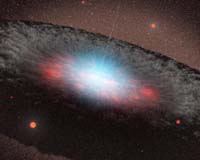
Washington DC (SPX) Aug 24, 2006 Supermassive black holes in some giant galaxies create such a hostile environment, they shut down the formation of new stars, according to NASA Galaxy Evolution Explorer findings published in the August 24 issue of Nature. The orbiting observatory surveyed more than 800 nearby elliptical galaxies of various sizes. An intriguing pattern emerged: the more massive, or bigger, the galaxy, the less likely it was to have young stars. Because bigger galaxies are known to have bigger black holes, astronomers believe the black holes are responsible for the lack of youthful stars. "Supermassive black holes in these giant galaxies create unfriendly places for stars to form," said Dr. Sukyoung K. Yi of Yonsei University in Seoul, Korea, who led the research team. "If you want to find lots of young stars, look to the smaller galaxies." Previously, scientists had predicted that black holes might have dire consequences for star birth, but they didn't have the tools necessary to test the theory. The Galaxy Evolution Explorer, launched in 2003, is well-suited for this research. It is extremely sensitive to the ultraviolet radiation emitted by even low numbers of young stars. Black holes are monstrous heaps of dense matter at the centers of galaxies. Over time, a black hole and its host galaxy will grow in size, but not always at the same rate. Yi and his collaborators found evidence that the black holes in elliptical galaxies bulk up to a critical mass before putting a stop to star formation. In other words, once a black hole reaches a certain size relative to its host galaxy, its harsh effects become too great for new stars to form. According to this "feedback" theory, the growth of a black hole slows the development of not only stars but of its entire galaxy. How does a black hole do this? There are two possibilities. First, jets being blasted out of black holes could blow potential star-making fuel, or gas, out of the galaxy center, where stars tend to arise. The second theory relates to the fact that black holes drag surrounding gas onto them, which heats the gas. The gas becomes so hot that it can no longer clump together and collapse into stars. Other authors of this research include: Drs. Kevin Schawinski, Sadegh Khochfar and Sugata Kaviraj of the University of Oxford, England; Dr. Young-Wook Lee of Yonsei University in Seoul, Korea; Drs. Alessandro Boselli, Jose Donas and Bruno Milliard of the Laboratory of Astrophysics of Marseille, France; Tim Conrow, Drs. Tom Barlow, Karl Forster, Peter G. Friedman, D. Chris Martin, Patrick Morrissey, Mark Seibert, Todd Small and Ted K. Wyder of the California Institute of Technology in Pasadena; Dr. Susan Neff of NASA's Goddard Space Flight Center, Greenbelt, Maryland; Dr. David Schiminovich of Columbia University, N.Y.; Drs. Tim Heckman, Alex Szalay and Luciana Bianchi of Johns Hopkins University, Baltimore, Md.; Dr, Barry Madore of the Observatories of the Carnegie Institute of Washington in Pasadena; and Dr. R. Michael Rich of the University of California, Los Angeles. Related Links Galaxy Evolution Explorer home page  Mathematics Used To Study Abstract Spaces
 Champaign (UPI) Aug 16, 2006
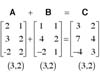
A University of Illinois mathematician is using topology to study abstract spaces and solve complex problems in a study funded by the U.S. government. Mathematician Robert Ghrist says studying complex systems, such as the movement of robots on a factory floor, the motion of air over a wing, or the effectiveness of a security network, can present huge challenges so he is developing advanced mathematical tools to simplify such tasks. |
|
|

| The content herein, unless otherwise known to be public domain, are Copyright 1995-2006 - SpaceDaily.AFP and UPI Wire Stories are copyright Agence France-Presse and United Press International. ESA PortalReports are copyright European Space Agency. All NASA sourced material is public domain. Additionalcopyrights may apply in whole or part to other bona fide parties. Advertising does not imply endorsement,agreement or approval of any opinions, statements or information provided by SpaceDaily on any Web page published or hosted by SpaceDaily. Privacy Statement |