
 |
 |
 |
 |
 |
 |
 |
 |
 |
 |

| . |  |
. |

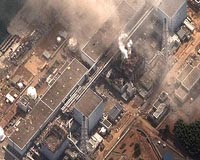
Vienna (AFP) March 30, 2011 Radiation levels recorded at a village outside the evacuation zone around the quake-striken Fukushima nuclear plant are above safe levels, the UN atomic watchdog said Wednesday. The International Atomic Energy Agency said safe limits had been exceeded at Iitate village, 40 kilometres (25 miles) northwest of Fukushima, well outside the government-imposed 20 kilometre exclusion zone and the 30-kilometre "stay indoors" zone. "The first assessment indicates that one of the IAEA operational criteria for evacuation is exceeded in Iitate village," the IAEA's head of nuclear safety and security, Denis Flory, told reporters here. The watchdog had advised Japanese authorities to "carefully assess the situation and they have indicated that it is already under assessment," Flory said. But he said the IAEA -- which does not have the mandate to order national authorities to act -- was not calling for a general widening of the exclusion zone. Iitate lies 40 kilometres (25 miles) northwest of the Fukushima nuclear power plant, which was crippled by a tsunami on March 11 and several explosions, leading to frantic efforts to prevent a catastrophic meltdown. Advice had been given to "carefully assess the situation and they have indicated that it is already under assessment," he said. The reading in Iitate was merely a spot reading, he said. "Deposition of radioactivity is something which is not the same everywhere, it depends on wind, it depends on rain and also on profile of terrain," Flory said. "Saying at one point that there is a need to assess further does not mean that all around that is a concern." But he said that overall, the situation at Fukushima "remains very serious." According to Elena Buglova, head of the IAEA's Incident and Emergency Centre, the reading in Iitate village was 2 megabecquerels per square metre. That was a "ratio about two times higher than levels" at which the agency recommends evacuations, she explained.
earlier related report A spokesman for Tokyo Electric Power Co., operator of the Fukushima Daiichi nuclear plant crippled by a March 11 earthquake and tsunami, said levels of radioactive iodine-131 were 3,355 times the legal limit in the sea near the plant, according to a reading taken Tuesday. Officials said they did not know what cause the radiation level to rise. "The figures are rising further. We need to find out as quickly as possible the causes and to stop them from rising any higher," said nuclear safety agency spokesman Hidehiko Nishiyama. The sampling location is 330 metres south of the discharge outlet for four troubled reactors. Officials have said that tidal dispersion means that there is no immediate health threat, and that the iodine degrades relatively quickly. A 9.0 magnitude earthquake and tsunami knocked out the cooling systems of the Fukushima plant's six reactors -- triggering explosions and fires, releasing radiation and sparking global fears of a widening disaster. Radiation from the plant northeast of Tokyo has wafted into the air, contaminating farm produce and drinking water, and seeped into the Pacific Ocean. In a stop-gap measure to contain the crisis at the plant, crews have poured thousands of tons of water onto reactors where fuel rods are thought to have partially melted, and topped up pools for spent fuel rods. But the run-off of the operation has accumulated in the basements of turbine rooms connected to three reactors and filled up tunnels, making it too risky for workers to go near to repair cooling systems needed to stabilise the plant. The water out of reactor two has measured 1,000 millisieverts per hour -- four times the recently-hiked total exposure limit for emergency staff, and a level that can cause radiation sickness with nausea and vomiting in an hour. On Sunday, iodine-131 measuring 1,850 times the legal maximum were reported a few hundred metres (yards) from the plant, up from 1,250 times the limit Saturday. Japan's government has evacuated hundreds of thousands of people from within 20 kilometres of the plant, and more recently encouraged those remaining within 30 kilometres to also leave.
Share This Article With Planet Earth
Related Links Space Technology News - Applications and Research

 Anti-radiation resin to coat Japan plant grounds
Osaka (AFP) March 30, 2011 Workers at Japan's stricken Fukushima nuclear power plant plan to spray its grounds with a special resin to prevent further radioactivity being released, a nuclear safety agency official said Wednesday. Faced with an unprecedented crisis, authorities are grappling to control four crippled reactors that have been leaking dangerous radiation after a March 11 earthquake and tsunami knocked out ... read more |
|
|
| The content herein, unless otherwise known to be public domain, are Copyright 1995-2010 - SpaceDaily. AFP and UPI Wire Stories are copyright Agence France-Presse and United Press International. ESA Portal Reports are copyright European Space Agency. All NASA sourced material is public domain. Additional copyrights may apply in whole or part to other bona fide parties. Advertising does not imply endorsement,agreement or approval of any opinions, statements or information provided by SpaceDaily on any Web page published or hosted by SpaceDaily. Privacy Statement |


 del.icio.us
 Digg
Digg Reddit
 YahooMyWeb
 Google
 Facebook


