
 |
 |
 |
 |
 |
 |
 |
 |
 |
 |

| . |  |
. |

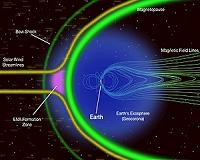
Moffett Field CA (SPX) Aug 19, 2010 Since its October 2008 launch, NASA's Interstellar Boundary Explorer (IBEX) spacecraft has mapped the invisible interactions occurring at the edge of the solar system. The images reveal that the interactions between our home in the galaxy and interstellar space are surprisingly structured and intense. IBEX provides global imaging of the interstellar boundary much like a weather satellite provides data about global and regional weather patterns on Earth. The Voyager spacecraft are like weather stations and provide pioneering point measurements of interactions in the interstellar boundary region from their two locations. Using the most sensitive neutral atom detectors ever flown in space, IBEX went far beyond those measurements by unveiling a striking, narrow ribbon of particles two to three times more intense than anything else in the sky. The Voyager measurements gave no indication of the ribbon's presence and no theories or models had previously predicted its existence. Building on those first images of the interstellar boundary, the spacecraft has also directly collected hydrogen and oxygen from the interstellar medium for the first time and made the first observations of very fast hydrogen atoms coming from the Moon, following decades of speculation and searching for their existence. Hydrogen from the Sun's million mile per hour solar wind becomes embedded in the Moon's surface, so IBEX's measurements of the fraction of hydrogen atoms that bounce off the surface sheds critical light on the "recycling" processes undertaken by particles throughout the solar system and beyond. Most recently, IBEX data have been extended to observe the Earth's magnetosphere from the outside. The magnetic bubble that surrounds the Earth and interacts with the solar wind flowing out from the Sun has been studied extensively with various instruments and spacecraft from within, but IBEX has enabled the first direct observations from the outside. Just as the interstellar boundary shields the solar system from the majority of galactic cosmic ray radiation, so does the magnetosphere protect Earth from solar particle radiation. IBEX data show the pileup of the solar wind in front of the magnetopause, the boundary between the Earth's magnetosphere and interplanetary space, giving important new details about the processes that protect Earth's atmosphere. "The maps of the never-before-seen regions at the edge of our solar system have been remarkable enough," says Dr. David J. McComas, IBEX principal investigator and an assistant vice president at Southwest Research Institute in San Antonio. "But to see the IBEX data also being used to make other important discoveries in the space environment closer to Earth is an extremely exciting bonus for the science community and NASA." A number of other studies on the magnetosphere are in progress, including studies of the "night side," the plasma sheet, the tail and other magnetospheric structures. Studying the magnetosphere can help astrobiologists understand the habitability of our planet, and will aid in the search for similar planets orbiting distant stars. "Science is often a process of getting new observations, admitting that we don't know nearly as much as we thought we did, and building up new understanding from there," says McComas. "The fun part is when the science community is faced with new observations and is forced to debate new theories and ideas. It will take a while before the community comes to a consensus about what the IBEX data really mean, yet we've already learned much, much more about our place in the solar system."
Share This Article With Planet Earth
Related Links IBEX Stellar Chemistry, The Universe And All Within It

 IBEX Spacecraft Finds Discoveries Close To Home
Washington DC (SPX) Aug 17, 2010 Imagine floating 35,000 miles above the sunny side of Earth. Our home planet gleams below, a majestic whorl of color and texture. All seems calm around you. With no satellites or space debris to dodge, you can just relax and enjoy the black emptiness of space. But looks can be deceiving. In reality, you've unknowingly jumped into an invisible mosh pit of electromagnetic mayhem - the ... read more |
|
|
| The content herein, unless otherwise known to be public domain, are Copyright 1995-2010 - SpaceDaily. AFP and UPI Wire Stories are copyright Agence France-Presse and United Press International. ESA Portal Reports are copyright European Space Agency. All NASA sourced material is public domain. Additional copyrights may apply in whole or part to other bona fide parties. Advertising does not imply endorsement,agreement or approval of any opinions, statements or information provided by SpaceDaily on any Web page published or hosted by SpaceDaily. Privacy Statement |


 del.icio.us
 Digg
Digg Reddit
 YahooMyWeb
 Google
 Facebook


