|
 |
 |
 |
 |
 |
 |
 |

| . |  |
. |

|
|
. |

 by Staff Writers Washington (AFP) Aug 18, 2011
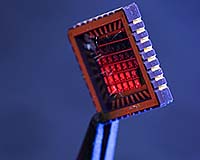
US computer giant IBM announced on Thursday that it has developed prototypes of computer chips that mimic the way the human brain works. The Armonk, New York-based company known as "Big Blue" said the experimental "cognitive computing chips" could eventually lead to machines that "emulate the brain's abilities for perception, action and cognition." "These chips are another significant step in the evolution of computers from calculators to learning systems, signaling the beginning of a new generation of computers," said Dharmendra Modha, project leader for IBM Research. "Future applications of computing will increasingly demand functionality that is not efficiently delivered by the traditional architecture," Modha said. IBM said cognitive computers, like the human brain, would "learn through experiences, find correlations, create hypotheses, and remember -- and learn from -- the outcomes." Roger Kay of Endpoint Technologies Associates said that IBM was "taking the architecture of the brain and saying 'Can we somehow make the electronics mimic what we know about the brain, how the brain works.'" "They haven't got to the point where it's doing any practical work yet but they've proven the concept out," Kay told AFP. "It's a new frontier." According to IBM, which has been conducting artificial intelligence research since 1956, the chips could lead to computers able to ingest complex, real-time information through multiple sensors and translate it into action. For example, a cognitive computing system monitoring the world's water supply could issue tsunami warnings using a network of sensors that monitor inputs such as temperature, pressure, wave height and acoustics. "Making sense of real-time input flowing at an ever-dizzying rate would be a Herculean task for today's computers, but would be natural for a brain-inspired system," IBM said. "Imagine traffic lights that can integrate sights, sounds and smells and flag unsafe intersections before disaster happens," Modha said. So far, IBM said, it has managed to carry out simple applications using the prototype chips like navigation, pattern recognition and classification. IBM said the cognitive computing chips replicate the biological synapses, neurons and axons of the human brain using algorithms and silicon circuitry. They feature integrated memory (replicated synapses), computation (replicated neurons) and communication (replicated axons), it said. The "long-term goal" of Big Blue is to build a chip system with 10 billion neurons and 100 trillion synapses which consumes just one kilowatt of power and occupies less than two liters of volume. For phase two of the project known as SyNAPSE -- or Systems of Neuromorphic Adaptive Plastic Scalable Electronics -- IBM said it has joined forces with researchers from Columbia University, Cornell University, the University of California (Merced) and University of Wisconsin (Madison). IBM said the project has received $21 million in new funding from the Pentagon's Defense Advanced Research Projects Agency (DARPA). Earlier this year, an IBM supercomputer known as Watson defeated two human contestants on the popular US television quiz show Jeopardy! Watson, named for IBM founder Thomas Watson, is capable of understanding natural human speech and quickly providing answers to complex questions. Watson was the latest machine developed by IBM to challenge mankind -- in 1997, an IBM computer named "Deep Blue" defeated world chess champion Garry Kasparov in a six-game match.
|
. |
|
| The content herein, unless otherwise known to be public domain, are Copyright 1995-2011 - Space Media Network. AFP and UPI Wire Stories are copyright Agence France-Presse and United Press International. ESA Portal Reports are copyright European Space Agency. All NASA sourced material is public domain. Additional copyrights may apply in whole or part to other bona fide parties. Advertising does not imply endorsement,agreement or approval of any opinions, statements or information provided by Space Media Network on any Web page published or hosted by Space Media Network. Privacy Statement |


 del.icio.us
 Digg
Digg Reddit
 Google