
 |
 |
 |
 |
 |
 |
 |
 |
 |
 |

| . |  |
. |

New Delhi, India (SPX) Dec 29, 2010 The Indian space research organization (ISRO) was not destined to end the year on a cheerful note. On Christmas eve its GSAT-5P satellite launch mission failed in the "first stage" of the launch process itself. This is the second biggest blow to ISRO this year. Earlier on April 15, 2010, its first attempt to use an indigenously made cryogenic engine to launch the GSAT-4 satellite failed. It may take ISRO another year to again test this technology. The recent launch was to take place on December 20 but was postponed due to certain technical difficulties faced during the countdown stage. The Christmas eve launch used a cryogenic engine purchased from Russia. GSAT-5P was expected to retire the ageing INSAT 2E (launched in 1999) and ensure continuity of telecom and television services in the country. Weighing 2,310 kg, the satellite had 36 transponders on board, out of which 24 were C band and 12 were extended C band transponders. All were to undertake automatic receiving and transmission of communication or broadcast signals. This satellite was expected to remain in service for more than 13 years and had an all India footprint. ISRO has a commendable launch record in satellites particularly with its Polar Satellite Launch Vehicle (PSLV). However, its history with regard to the Geosynchronous Satellite Launch Vehicle (GSLV) has not been very encouraging so far. GSLV is used for putting heavy satellites weighing around 2000 to 2500kg category into space (India has ambitions of putting 4000 kg satellites in space in the near future). Before the GSAT-5P/GSLV-F06 mission, ISRO had launched six other GLSV missions starting from 2001 but with only a 50 per cent success rate. In fact only two missions were fully successful and a third was a partial success. It is important to note here that within a span of a decade ISRO was attempting to increase the payload of this launch vehicle from 1,530 kg payload in 2001 to 2,310 kg now. Simply speaking an 800 kg increase in payload in a span of ten years is not a great achievement, and unfortunately ISRO could not even do that. However, it is also important to note that failures with regard to satellite launches are a global phenomena. On December 5, 2010 a Russian Proton-M rocket failed to launch three Glonass satellites into orbit. Last year NASA's first environmental satellite launch had also failed. Japan had also lost its telecommunications satellite JCSat 11 in 2007. This is part of what 'rocket science' is all about! Over the years ISRO has played a significant role in India's emergence as an economic, political and strategic power. ISRO's success or failure is directly related to India's prestige. Space technology has an important role to play in the "Rise of India". All heads of major powers (P-5) who visited India this year have taken a keen interest to engage India in the space sector. In fact the French President began his India tour by first visiting ISRO. The US and Russian Presidents want to engage India in a broad range of flagship projects in the space sector. The 12th World Market Survey of satellite construction and launch trends by a Paris based agency has predicted that India and China will play a major role in the space market by deciding the global launch and satellite prices. Naturally, such launch failures will create image problems for ISRO and could adversely impact on its business interests. ISRO's failure in the GSLV category needs to be viewed seriously, given that in the next two decades the core commercial market is likely to be ruled by telecommunications satellites in geostationary orbit. Also, this vehicle is central to India's future space programmes like the second moon mission, manned space mission, etc. In the past particularly before the year 2000 ISRO's success rate was almost 60 per cent, which was somewhat below the global standards. During the last decade ISRO has indeed raised expectations of the entire country with some momentous successes. Now, the onus lies on ISRO to quickly study the failures of past launches and enhance the reliability of the GSLV. It also does not have much choice left as far as cryogenic engines are concerned, given that only one of these engines acquired from Russia remains. ISRO has to succeed in perfecting the indigenous cryogenic engines programme to take the GSLV programme ahead. It has been reported that India has plans to launch five heavy satellites in the next two years to expand its telecommunications and broadcasting constellation in space. It is important that ISRO masters this technology at the earliest. It could follow a two pronged approach in this regard. To cater for immediate communication requirements it could ask other countries to launch Indian satellites for the present. Simultaneously, it could conduct GSLV testing along with the indigenously-developed Cryogenic Upper Stage (CUS) by launching dummy payloads. In Asia the performance of other space powers like China and Japan is significant. China in particular is making very rapid progress in this sector and its success rate is noteworthy. ISRO needs to conduct a thorough enquiry particularly because failure in a time-tested and launch proven "stage one technology" is undesirable.
Share This Article With Planet Earth
Related Links Institute for Defence Studies and Analyses (IDSA) Space Analysis and Space OpEds

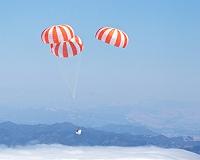 Year Of The Dragon
Bethesda MD (SPX) Dec 15, 2010 A new era in spaceflight opened last Wednesday with the successful first flight of Space Exploration Technologies' (SpaceX) Dragon capsule by a non-government entity. It demonstrated the ability to maneuver on orbit, deorbit, enter the atmosphere, deploy its parachutes, and be recovered intact. Had it had people on board, which it could have, with its rudimentary short-duration life suppor ... read more |
|
|
| The content herein, unless otherwise known to be public domain, are Copyright 1995-2010 - SpaceDaily. AFP and UPI Wire Stories are copyright Agence France-Presse and United Press International. ESA Portal Reports are copyright European Space Agency. All NASA sourced material is public domain. Additional copyrights may apply in whole or part to other bona fide parties. Advertising does not imply endorsement,agreement or approval of any opinions, statements or information provided by SpaceDaily on any Web page published or hosted by SpaceDaily. Privacy Statement |


 del.icio.us
 Digg
Digg Reddit
 YahooMyWeb
 Google
 Facebook


