|
 |
 |
 |
 |
 |
 |
 |
 |
 |

| . |  |
. |
Instruments And Science Team Selected For Next Generation Space Telescope
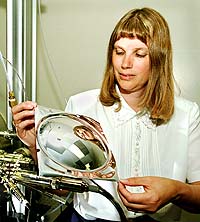
Washington - June 10, 2002 NASA has selected a team led by the University of Arizona, Tucson, to provide the primary near-infrared science camera for the Next Generation Space Telescope (NGST), NASA's successor to the Hubble Space Telescope. Scheduled for launch in 2010, the new telescope's primary science objective will be to look back to an extremely important period in the early history of the Universe when the first stars and galaxies began to form shortly after the big bang. To achieve this goal, the NGST will require much more light-gathering capability than Hubble, meaning it will need a much larger primary mirror. At approximately 6 meters (20 feet) in diameter, NGST's primary mirror will be more than two-and- a-half times as large as the Hubble telescope, which is scheduled for "retirement" in 2010 after a 20-year mission in space. In addition to a large light-gathering mirror, NGST will need to operate at near- and mid-infrared wavelengths to better detect the light from extremely distant and faint objects. NGST will study infrared (heat) emissions from objects that formed when the Universe was between one million and a few billion years old. It will be capable of seeing objects 400 times fainter than those currently studied with large ground-based telescopes or the current generation of space-based infrared telescopes. Its tennis-court-size sunshade will help eliminate heat from the sun, which is necessary for reducing heat "pollution" from the surrounding environment. The telescope will be built by an industry team that NASA will select later this summer. The winning primary camera team includes members from the University of Arizona; Lockheed-Martin Advanced Technology Center, Palo Alto, Calif.; EMS Technologies, Ottawa, Canada; and COMDEV, Ltd., Cambridge, Canada, and will be led by Dr. Marcia Rieke of the University of Arizona. In addition to selecting the main imaging camera, NASA has chosen the U.S. portion of an international team that will construct a mid-infrared instrument. The members of this team are Dr. Thomas Greene, NASA's Ames Research Center, Moffett Field, Calif.; Dr. Margaret Meixner, University of Illinois, Urbana-Champaign; and Dr. George Rieke, University of Arizona. These scientists, lead by Dr. George Rieke, will work in collaboration with scientists and engineers led by Dr. Gene Serabyn from NASA's Jet Propulsion Laboratory, Pasadena, Calif., and the European Space Agency to enable NGST to see farther into the infrared portion of the spectrum. This capability will permit NGST to study stars forming inside dense clouds of interstellar dust that block Hubble's vision. NASA has also selected several scientists to serve, with the principal instrument scientists, on the NGST science working group. This group will provide scientific guidance during the development of the telescope. The selected scientists are Dr. Heidi Hammel, Space Science Institute, Ridgefield, Conn.; Dr. Simon Lilly, ETH- Hoenggerberg, Zurich, Switzerland; Dr. Jonathan Lunine, Lunar and Planetary Laboratory, Tucson, Ariz.; Dr. Mark McCaughrean, Potsdam, Germany; Dr. Massimo Stiavelli, Space Telescope Science Institute, Baltimore; and Dr. Rogier Windhorst, Arizona State University, Tempe. NGST Program at NASA http://ngst.gsfc.nasa.gov/ Related LinksSpaceDaily Search SpaceDaily Subscribe To SpaceDaily Express  ESA's Microgravity Science Glovebox On Station
 Paris - June 10, 2002
ESA's Microgravity Science Glovebox (MSG) was delivered to the Internation Space Station as part of the logistics module, MPLM-Leonardo that Endeavour transported to the station.
--------------------------------------------------------- It's new. And it's downright terrific! Celestron's CPC Schmidt-Cassegrain telescope is the scope you've been waiting for! It offers new alignment technology, advanced engineering, and bold new design at a new, low price! In fact, Celestron's Professional Computerized (CPC) scope with revolutionary SkyAlign Alignment Technology redefines everything that amateur astronomers are looking for. It offers quick and simple alignment, GPS technology, unsurpassed optical quality, ease of use, advanced ergonomics, enhanced computerization and, most important, affordability. Want to view M-31 tonight? One button takes you there!
Shop for telescopes online at Telescopes.com! today!
|
|
|

| The content herein, unless otherwise known to be public domain, are Copyright 1995-2006 - SpaceDaily.AFP and UPI Wire Stories are copyright Agence France-Presse and United Press International. ESA PortalReports are copyright European Space Agency. All NASA sourced material is public domain. Additionalcopyrights may apply in whole or part to other bona fide parties. Advertising does not imply endorsement,agreement or approval of any opinions, statements or information provided by SpaceDaily on any Web page published or hosted by SpaceDaily. Privacy Statement |