|
 |
 |
 |
 |
 |
 |
 |

| . |  |
. |

|
|
. |

 by Staff Writers Cambridge, MA (SPX) Sep 09, 2011
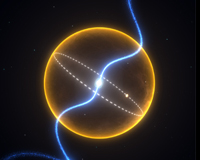
Usually, running five minutes late is a bad thing since you might lose your dinner reservation or miss out on tickets to the latest show. But when a planet runs five minutes late, astronomers get excited because it suggests that another world is nearby. NASA's Kepler spacecraft has spotted a planet that alternately runs late and early in its orbit because a second, "invisible" world is tugging on it. This is the first definite detection of a previously unknown planet using this method. No other technique could have found the unseen companion. "This invisible planet makes itself known by its influence on the planet we can see," said astronomer Sarah Ballard of the Harvard-Smithsonian Center for Astrophysics (CfA). Ballard is lead author on the study, which has been accepted for publication in The Astrophysical Journal. "It's like having someone play a prank on you by ringing your doorbell and running away. You know someone was there, even if you don't see them when you get outside," she added. Both the seen and unseen worlds orbit the Sun-like star Kepler-19, which is located 650 light-years from Earth in the constellation Lyra. The 12th-magnitude star is well placed for viewing by backyard telescopes on September evenings. Kepler locates planets by looking for a star that dims slightly as a planet transits the star, passing across the star's face from our point of view. Transits give one crucial piece of information - the planet's physical size. The greater the dip in light, the larger the planet relative to its star. However, the planet and star must line up exactly for us to see a transit. The first planet, Kepler-19b, transits its star every 9 days and 7 hours. It orbits the star at a distance of 8.4 million miles, where it is heated to a temperature of about 900 degrees Fahrenheit. Kepler-19b has a diameter of 18,000 miles, making it slightly more than twice the size of Earth. It may resemble a "mini-Neptune," however its mass and composition remain unknown. If Kepler-19b were alone, each transit would follow the next like clockwork. Instead, the transits come up to five minutes early or five minutes late. Such transit timing variations show that another world's gravity is pulling on Kepler-19b, alternately speeding it up or slowing it down. Historically, the planet Neptune was discovered similarly. Astronomers tracking Uranus noticed that its orbit didn't match predictions. They realized that a more distant planet might be nudging Uranus and calculated the expected location of the unseen world. Telescopes soon observed Neptune near its predicted position. "This method holds great promise for finding planets that can't be found otherwise," stated Harvard astronomer and co-author David Charbonneau. So far, astronomers don't know anything about the invisible world Kepler-19c, other than that it exists. It weighs too little to gravitationally tug the star enough for them to measure its mass. And Kepler hasn't detected it transiting the star, suggesting that its orbit is tilted relative to Kepler-19b. "Kepler-19c has multiple personalities consistent with our data. For instance, it could be a rocky planet on a circular 5-day orbit, or a gas-giant planet on an oblong 100-day orbit," said co-author Daniel Fabrycky of the University of California, Santa Cruz (UCSC). The Kepler spacecraft will continue to monitor Kepler-19 throughout its mission. Those additional data will help nail down the orbit of Kepler-19c. Future ground-based instruments like HARPS-North will attempt to measure the mass of Kepler-19c. Only then will we have a clue to the nature of this invisible world. Related Links Harvard-Smithsonian Center Lands Beyond Beyond - extra solar planets - news and science Life Beyond Earth
|
. |
|
| The content herein, unless otherwise known to be public domain, are Copyright 1995-2011 - Space Media Network. AFP and UPI Wire Stories are copyright Agence France-Presse and United Press International. ESA Portal Reports are copyright European Space Agency. All NASA sourced material is public domain. Additional copyrights may apply in whole or part to other bona fide parties. Advertising does not imply endorsement,agreement or approval of any opinions, statements or information provided by Space Media Network on any Web page published or hosted by Space Media Network. Privacy Statement |

 del.icio.us
 Digg
Digg Reddit
 Google