|
 |
 |
 |
 |
 |
 |
 |
 |
 |

| . |  |
. |
Is A New Solar Cycle Beginning
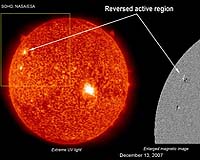
Huntsville AL (SPX) Dec 17, 2007 The solar physics community is abuzz this week. No, there haven't been any great eruptions or solar storms. The source of the excitement is a modest knot of magnetism that popped over the sun's eastern limb on Dec. 11th, pictured below in a pair of images from the orbiting Solar and Heliospheric Observatory (SOHO). It may not look like much, but "this patch of magnetism could be a sign of the next solar cycle," says solar physicist David Hathaway of the Marshall Space Flight Center. For more than a year, the sun has been experiencing a lull in activity, marking the end of Solar Cycle 23, which peaked with many furious storms in 2000--2003. "Solar minimum is upon us," he says. The big question now is, when will the next solar cycle begin? It could be starting now. "New solar cycles always begin with a high-latitude, reversed polarity sunspot," explains Hathaway. "Reversed polarity " means a sunspot with opposite magnetic polarity compared to sunspots from the previous solar cycle. "High-latitude" refers to the sun's grid of latitude and longitude. Old cycle spots congregate near the sun's equator. New cycle spots appear higher, around 25 or 30 degrees latitude. The region that appeared on Dec. 11th fits both these criteria. It is high latitude (24 degrees N) and magnetically reversed. Just one problem: There is no sunspot. So far the region is just a bright knot of magnetic fields. If, however, these fields coalesce into a dark sunspot, scientists are ready to announce that Solar Cycle 24 has officially begun. Many forecasters believe Solar Cycle 24 will be big and intense. Peaking in 2011 or 2012, the cycle to come could have significant impacts on telecommunications, air traffic, power grids and GPS systems. (And don't forget the Northern Lights!) In this age of satellites and cell phones, the next solar cycle could make itself felt as never before. The furious storms won't start right away, however. Solar cycles usually take a few years to build to a frenzy and Cycle 24 will be no exception. "We still have some quiet times ahead," says Hathaway. Meanwhile, all eyes are on a promising little active region. Will it become the first sunspot of a new solar cycle? Stay tuned for updates from Science@NASA. Community Email This Article Comment On This Article Related Links Solar Science News at SpaceDaily
 Cluster Explains The Presence Of High-Speed Ion Beams In The Magnetotail
 Paris, France (ESA) Dec 12, 2007
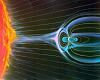
Understanding how solar material manages to reach the nightside of the Earth and flows back to Earth at high speeds is key to forecast the behaviour of the magnetic environment of the Earth and to protect space-based technologies. A recent study reveals for the first time that the tail of the magnetosphere is a place where ions can get highly accelerated simultaneously at different localized sites distributed along the tail axis. |
|
|

| The content herein, unless otherwise known to be public domain, are Copyright 1995-2006 - SpaceDaily.AFP and UPI Wire Stories are copyright Agence France-Presse and United Press International. ESA PortalReports are copyright European Space Agency. All NASA sourced material is public domain. Additionalcopyrights may apply in whole or part to other bona fide parties. Advertising does not imply endorsement,agreement or approval of any opinions, statements or information provided by SpaceDaily on any Web page published or hosted by SpaceDaily. Privacy Statement |