|
 |
 |
 |
 |
 |
 |
 |
 |
 |

| . |  |
. |
Is There Anybody Out There
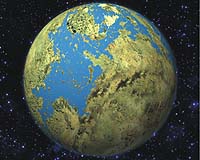
Norwich, UK (SPX) Apr 18, 2008 Is there anybody out there? Probably not, according to a scientist from the University of East Anglia. A mathematical model produced by Prof Andrew Watson suggests that the odds of finding new life on other Earth-like planets are low, given the time it has taken for beings such as humans to evolve and the remaining life span of Earth. Structurally complex and intelligent life evolved late on Earth and it has already been suggested that this process might be governed by a small number of very difficult evolutionary steps. Prof Watson, from the School of Environmental Sciences, takes this idea further by looking at the probability of each of these critical steps occurring in relation to the life span of Earth, giving an improved mathematical model for the evolution of intelligent life. According to Prof Watson a limit to evolution is the habitability of Earth, and any other Earth-like planets, which will end as the sun brightens. Solar models predict that the brightness of the sun is increasing, while temperature models suggest that because of this the future life span of Earth will be 'only' about another billion years, a short time compared to the four billion years since life first appeared on the planet. "The Earth's biosphere is now in its old age and this has implications for our understanding of the likelihood of complex life and intelligence arising on any given planet," said Prof Watson. "At present, Earth is the only example we have of a planet with life. If we learned the planet would be habitable for a set period and that we had evolved early in this period, then even with a sample of one, we'd suspect that evolution from simple to complex and intelligent life was quite likely to occur. By contrast, we now believe that we evolved late in the habitable period, and this suggests that our evolution is rather unlikely. In fact, the timing of events is consistent with it being very rare indeed." Prof Watson suggests the number of evolutionary steps needed to create intelligent life, in the case of humans, is four. These probably include the emergence of single-celled bacteria, complex cells, specialized cells allowing complex life forms, and intelligent life with an established language. "Complex life is separated from the simplest life forms by several very unlikely steps and therefore will be much less common. Intelligence is one step further, so it is much less common still," said Prof Watson. His model, published in the journal Astrobiology, suggests an upper limit for the probability of each step occurring is 10 per cent or less, so the chances of intelligent life emerging is low - less than 0.01 per cent over four billion years. Each step is independent of the other and can only take place after the previous steps in the sequence have occurred. They tend to be evenly spaced through Earth's history and this is consistent with some of the major transitions identified in the evolution of life on Earth. Community Email This Article Comment On This Article Related Links University of East Anglia Life Beyond Earth Lands Beyond Beyond - extra solar planets - news and science
 Intelligence: A Rare Cosmic Commodity
 Moffett Field CA (SPX) Apr 15, 2008
Advanced ground and space-based telescopes are discovering new planets around other stars almost daily, but an environmental scientist from England believes that even if some of those planets turn out to be Earth-like, the odds are very low they'll have intelligent inhabitants. In a recent paper published in the journal Astrobiology, Professor Andrew Watson of the University of East Anglia describes an improved mathematical model for the evolution of intelligent life as the result of a small number of discrete steps. |
|
|

| The content herein, unless otherwise known to be public domain, are Copyright 1995-2007 - SpaceDaily.AFP and UPI Wire Stories are copyright Agence France-Presse and United Press International. ESA Portal Reports are copyright European Space Agency. All NASA sourced material is public domain. Additional copyrights may apply in whole or part to other bona fide parties. Advertising does not imply endorsement,agreement or approval of any opinions, statements or information provided by SpaceDaily on any Web page published or hosted by SpaceDaily. Privacy Statement |