. Military Space News .
It's The Trees, Stupid

a planet without trees

Greenbelt - Oct 02, 2002
While many scientists and policy makers have focused only on how heat-trapping gases like carbon dioxide are altering our global climate, a new NASA-funded study points to the importance of also including human-caused land-use changes as a major factor contributing to climate change.

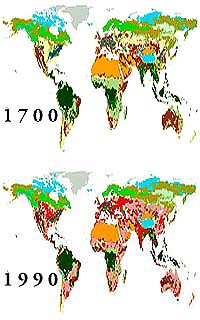
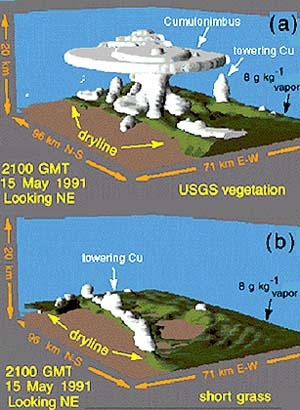
Land surface changes, like urban sprawl, deforestation and reforestation, and agricultural and irrigation practices strongly affect regional surface temperatures, precipitation and larger-scale atmospheric circulation.

The study argues that human-caused land surface changes in places like North America, Europe, and southeast Asia, redistribute heat regionally and globally within the atmosphere and may actually have a greater impact on climate than that due to anthropogenic greenhouse gases combined.

The study also proposes a new method for comparing different human-influenced agents of climate change in terms of the redistribution of heat over land and in the atmosphere. Using a single unit of measurement may open the door to future work that more accurately represents human-caused climate change.

"Our work suggests that the impacts of human-caused landcover changes on climate are at least as important, and quite possibly more important than those of carbon dioxide," said Roger Pielke, Sr., an atmospheric scientist at Colorado State University, Fort Collins, Colo., and lead author of the study.

"Through landcover changes over the last 300 years, we may have already altered the climate more than would occur associated with the radiative effect of a doubling of carbon dioxide." If carbon dioxide (CO2) emissions continue at current rates, atmospheric CO2 concentrations are expected to double by 2050. Land surface changes will also continue to occur.


Related Links
Links at GSFC Report
SpaceDaily
Search SpaceDaily
Subscribe To SpaceDaily Express

Stratospheric Winds May Make South Ozone Hole Collapse Short Term
Greenbelt - Oct 02, 2002
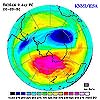
Scientists from NASA and the Commerce Department's National Oceanic and Atmospheric Administration (NOAA) have confirmed the ozone hole over the Antarctic this September is not only much smaller than it was in 2000 and 2001, but has split into two separate "holes."


  • US Warned Not To Ignore Chinese Military Advances

  • Successful Launch of Minuteman III ICBM Do Art On A Mass Scale
  • Kashmiris Vote As Indian And Pakistani Guns Boom
  • India, Pakistan Back to Sparring over Kashmir
  • Indian Untouchable Rockets To Presidential Heights

  • New Technology For Straying Missiles
  • SLAM-ER Becomes First Missile with Operational Automatic Target Acquisition
  • Batting Them Out Of The Sky
  • Taiwan Takes China's Military Threat Seriously: Defense Ministry

  • Lockheed Martin To Study Big Target Rocket Concepts
  • Missiles In "Position" As India Mulls Further Action Against Pakistan
  • Abm Pullout: The Phonecall That Soured Putin's Year. Or Did It?
  • US Official Defends Plans for Missile Defense Despite Test Failure

  • Yeager To Retire From Military Flying After October Airshow
  • Yeager To Retire From Military Flying After October Airshow
  • Boeing Signs Technology Development Agreement With JAI For Work On Sonic Cruiser
  • Boeing Sonic Cruiser Completes First Wind Tunnel Tests

  • Northrop Grumman Completes Fire Scout Production Configuration
  • Rumsfeld shows video of Iraqi attacks on US planes
  • UAVs Snap Iraqi Anti Aircraft Artillery
  • Vought/Alliant Techsystems To Give Global Hawk Its Wings


  • The content herein, unless otherwise known to be public domain, are Copyright 1995-2006 - SpaceDaily.AFP and UPI Wire Stories are copyright Agence France-Presse and United Press International. ESA PortalReports are copyright European Space Agency. All NASA sourced material is public domain. Additionalcopyrights may apply in whole or part to other bona fide parties. Advertising does not imply endorsement,agreement or approval of any opinions, statements or information provided by SpaceDaily on any Web page published or hosted by SpaceDaily. Privacy Statement