
 |
 |
 |
 |
 |
 |
 |
 |
 |
 |

| . |  |
. |
JPL Camera Marks Hubble's 100,000th Orbit
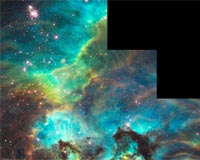
Pasadena CA (SPX) Aug 13, 2008 In commemoration of NASA's Hubble Space Telescope completing its 100,000th orbit, scientists used the JPL-built Wide Field and Planetary Camera 2 to take a snapshot of a dazzling region of a nebula 170,000 light-years away (near the Tarantula nebula). Hubble peered into a small portion of the nebula near the star cluster NGC 2074 (upper, left). The region, a firestorm of raw stellar creation, is one of the most active star-forming regions in our Local Group of galaxies. Scientists speculate it was perhaps triggered by a nearby supernova explosion. The three-dimensional-looking image reveals dramatic ridges and valleys of dust, serpent-head "pillars of creation," and gaseous filaments glowing fiercely under torrential ultraviolet radiation. The region is on the edge of a dark molecular cloud that is an incubator for the birth of new stars. The high-energy radiation blazing out from clusters of hot young stars already born in NGC 2074 is sculpting the wall of the nebula by slowly eroding it away. Another young cluster may be hidden beneath a circle of brilliant blue gas at center, bottom. In this approximately 100-light-year-wide, fantasy-like landscape, dark towers of dust rise above a glowing wall of gases on the surface of the molecular cloud. The seahorse-shaped pillar at the lower right is approximately 20 light-years long, roughly four times the distance between our sun and the nearest star, Alpha Centauri. The region is in the Large Magellanic Cloud, a satellite of our Milky Way galaxy. It is a fascinating laboratory for observing star-formation regions and their evolution. Dwarf galaxies like the Large Magellanic Cloud are considered to be the primitive building blocks of larger galaxies. This representative color image was taken by the Wide Field and Planetary Camera 2 on August 10, 2008, by scientists at the Space Telescope Science Institute in Baltimore, Md. Red shows emission from sulfur atoms, green from glowing hydrogen, and blue from glowing oxygen. The camera, the workhorse of Hubble imaging and its longest surviving instrument, will be returned to Earth during the final space shuttle mission to Hubble in October. Community Email This Article Comment On This Article Share This Article With Planet Earth
Related Links Space Telescope News and Technology at Skynightly.com
 Final Shuttle Mission To Hubble Space Telescope
 Houston TX (SPX) Aug 08, 2008
Veteran astronaut Scott D. Altman will command the final space shuttle mission to Hubble. Navy Reserve Capt. Gregory C. Johnson will serve as pilot. |
|
|

| The content herein, unless otherwise known to be public domain, are Copyright 1995-2007 - SpaceDaily.AFP and UPI Wire Stories are copyright Agence France-Presse and United Press International. ESA Portal Reports are copyright European Space Agency. All NASA sourced material is public domain. Additional copyrights may apply in whole or part to other bona fide parties. Advertising does not imply endorsement,agreement or approval of any opinions, statements or information provided by SpaceDaily on any Web page published or hosted by SpaceDaily. Privacy Statement |
 del.icio.us
 Digg
Digg Reddit
 YahooMyWeb
 Google
 Facebook