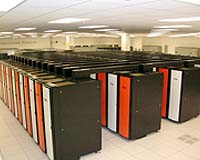
illustration only
illustration only |
The system recently completed acceptance testing, running applications in climate science, quantum chemistry, combustion science, materials science, nanoscience, fusion science, and astrophysics, as well as benchmarking applications that test supercomputing performance.
The Jaguar system, a Cray XT4 located at ORNL's National Center for Computational Sciences, now uses more than 31,000 processing cores to deliver up to 263 trillion calculations a second (or 263 teraflops).
"The Department of Energy's Leadership Computing Facility is putting unprecedented computing power in the hands of leading scientists to enable the next breakthroughs in science and technology," said ORNL Director Thom Mason. "This upgrade is an essential step along that path, bringing us ever closer to the era of petascale computing [systems capable of thousands of trillions of calculations per second]."
Jaguar was among the most powerful computing systems within DOE's Office of Science even before the recent upgrade and has delivered extraordinary results across a broad range of computational sciences.
"The leadership capability at Oak Ridge has been delivering real scientific results," said Michael Strayer, associate director for advanced scientific computing research in the DOE Office of Science.
"Benoit Roux of the University of Chicago used Jaguar to simulate in unprecedented detail the voltage-gated potassium channel, a membrane protein that responds to spikes of electricity by changing shape to allow potassium ions to enter a cell. This work has the potential to help us understand and control certain forms of cardiovascular and neurological disease."
Climate scientists are calculating the potential consequences of greenhouse gas emissions and the potential benefits of limiting these emissions. Combustion scientists are modeling the most efficient designs for engines that use fossil fuels and biofuels.
Fusion researchers are using the system to lead the way toward a clean and plentiful source of electricity. Physicists are exploring the secrets of the universe, illuminating its most elusive mysteries. And materials scientists are searching for the next revolution in technology.
"This is an important advancement," said Thomas Zacharia, ORNL associate laboratory director for computing and computational sciences.
"Leading researchers need many orders of magnitude more computing power and infrastructure than we can yet provide, and they have shown us how they will use these new resources, whether it be to predict the consequences of climate change at the regional level, design new materials with predetermined properties, discover new chemical catalysts, explore more efficient ways to manufacture biofuels, or simulate all important aspects of new reactor designs."
"The U.S. Department of Energy and its Oak Ridge National Laboratory have been making huge strides in providing more and more simulation capabilities to advance some of the world's most important scientific and engineering research-and invaluable partners with Cray to push the leading edge of supercomputing," said Peter Ungaro, president and CEO of Cray.
"This upgrade is another big milestone in leadership computing and we, along with many others around the world, are looking forward to learning about the scientific breakthroughs that are borne as a result of this powerful new computing capability."
With its new power, Jaguar will be able to double its contribution to DOE's Innovative and Novel Computational Impact on Theory and Experiment program, which is revolutionizing key areas of science by facilitating the world's most challenging computer simulations.
The NCCS will host 30 INCITE projects in 2008 from universities, private industry, and government research laboratories, contributing more than 140 million processor hours on Jaguar.
Community
 del.icio.us del.icio.us |
 Digg Digg |
 Reddit Reddit |
 YahooMyWeb YahooMyWeb |
 Google Google |
 Facebook Facebook |
 NASA, Intel And SGI Team Up To Soup Up The Supercomputer
 Moffett Field CA (SPX) May 08, 2008
| The content herein, unless otherwise known to be public domain, are Copyright 1995-2007 - SpaceDaily.AFP and UPI Wire Stories are copyright Agence France-Presse and United Press International. ESA Portal Reports are copyright European Space Agency. All NASA sourced material is public domain. Additional copyrights may apply in whole or part to other bona fide parties. Advertising does not imply endorsement,agreement or approval of any opinions, statements or information provided by SpaceDaily on any Web page published or hosted by SpaceDaily. Privacy Statement |