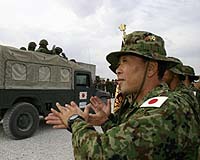
File photo of Japanese soldier in Iraq.
File photo of Japanese soldier in Iraq. |
The UN Peacekeeping Activities Cooperation Law currently allows Japan's Self-Defense Forces to use weapons only for protecting themselves and others when facing immediate danger.
The government is contemplating a revision of that law, which would permit troops to pre-emptively use their weapons to protect UN facilities and prevent captured people from escaping, the Yomiuri Shimbun said.
In these cases Japanese troops would be permitted to use arms even if their enemies were not launching attacks, the mass-circulation daily said, quoting sources close to the discussions.
However, the government was likely to limit the use of arms to situations in which it was obvious that the targets were non-traditional combatants such as guerrillas, terror operatives or criminal gang members, the Yomiuri said.
The shift in policy would make it easier for Japanese troops to participate in UN peacekeeping operations such as ceasefire monitoring, it said.
Last week, Japan created a full-fledged defense ministry for the first time since its World War II defeat and changed the status of the country's troops, listing overseas activities as one of their missions. Deployments abroad used to be considered "extraordinary", leading the government to seek parliamentary approval for specific missions.
In a groundbreaking move, Japan sent troops on a reconstruction mission to Iraq, the first time since 1945 that it had deployed to a country where fighting was underway.
The troops suffered no casualties and never fired their weapons, relying on Australian, British and Dutch forces to protect them.
Japan also sent close to 1,000 troops to Indonesia to assist with relief efforts after the December 2004 Indian Ocean tsunami.
Related Links
 Assuring Vital Interests Drives US Space Policy
 Colorado Springs, CO (SPX) Jan 11, 2007
| The content herein, unless otherwise known to be public domain, are Copyright 1995-2006 - SpaceDaily.AFP and UPI Wire Stories are copyright Agence France-Presse and United Press International. ESA PortalReports are copyright European Space Agency. All NASA sourced material is public domain. Additionalcopyrights may apply in whole or part to other bona fide parties. Advertising does not imply endorsement,agreement or approval of any opinions, statements or information provided by SpaceDaily on any Web page published or hosted by SpaceDaily. Privacy Statement |