
 |
 |
 |
 |
 |
 |
 |
 |
 |
 |

| . |  |
. |

Ofunato, Japan (AFP) April 4, 2011 Japan on Monday started to dump more than 10,000 tons of low-level radioactive water into the Pacific as part of emergency operations to stabilise its crippled Fukushima Daiichi nuclear plant. The last-resort measure came after the Bank of Japan said business confidence had plummeted since the earthquake and tsunami hit on March 11, plunging the country into its worst crisis since World War II. The UN atomic watchdog chief Yukiya Amano, meanwhile, said that the three-week-old Fukushima emergency, which Japan has predicted may last for months, meant an end to a "business as usual" approach to nuclear power. His comments appeared borne out when Japan signalled it may weaken its ambitious greenhouse gas cut targets, which are based on a continued heavy reliance on low-carbon atomic power, in light of the disaster. Japan has battled to prevent full reactor meltdowns at the tsunami-hit plant and poured thousands of tons of water onto overheating fuel rods, a stop-gap measure that has created highly radioactive run-off. To free up storage space for that run-off -- which has hampered crucial repair work and leaked into the Pacific -- operator the Tokyo Electric Power Company (TEPCO) said it would have to get rid of less toxic water. It insisted the release of the water -- the equivalent of more than four Olympic sized swimming pools -- would not harm marine life or seafood safety. But a TEPCO official fought back tears when he announced the step, saying: "We have already caused such pain and nuisance to local residents. We cannot express how sorry we are to have to impose another burden." Prime Minister Naoto Kan's top spokesman, Yukio Edano, said in a televised press conference: "We have no choice but to release water tainted with radioactive materials into the ocean as a safety measure." As a result of the massive water dumping operations, "highly radioactive waste water has accumulated at turbine buildings at Fukushima Daiichi, especially at the reactor unit two," said another TEPCO official. "There is a need to release already stored water in order to accept the additional waste water" totalling 10,000 tons, as well as 1,500 tons of water from pits under reactor units five and six, he said. Contamination from the plant has been found in the air, ground, seawater and, at lower concentrations, in regional produce including vegetables, dairy products, beef and, most recently, shiitake mushrooms. The nuclear emergency -- which has in many ways overshadowed the quake and tsunami that killed 12,020 people and left 15,512 missing -- has also hit the economy hard, sending stocks reeling and hitting manufacturing output. An updated version of the central bank's quarterly Tankan survey -- a key influence on monetary policy -- showed business confidence in the outlook for the next three months had plunged since the disaster. The government is considering asking manufacturers to start work an hour earlier than usual to ease electricity demand during the summer, when air conditioner use peaks, Kyodo news agency reported. Japan withdrew from the Copa America football tournament to be held in Argentina in July, saying it will need the period to catch up on domestic matches currently being postponed to avoid night-time electricity use. In Vienna, UN International Atomic Energy Agency chief Amano said the disaster "has enormous implications for nuclear power and confronts all of us with a major challenge." "The worries of millions of people throughout the world about whether nuclear energy is safe must be taken seriously," Amano said in an opening address to a special conference on nuclear safety. But Amano insisted that the basic drivers behind interest in nuclear power -- global energy demand, concerns about climate change, volatile fossil fuel prices and energy security -- "have not changed as a result of Fukushima." Japan's Edano earlier said that Tokyo's climate goal -- to cut emissions by 25 percent by 2020 from 1990 levels, if other big polluters do the same -- was now open to review along with many other policies. "Not only the 25 percent reduction target but also many other challenges that Japan is facing now should be examined at one point because many areas have been impacted by the quake disaster," Edano said. The Yomiuri Shimbun daily reported that the environment ministry's top bureaucrat Hideki Minamikawa had told reporters at UN climate talks in Bangkok that "the reduction goal will be affected a great deal". Resource-poor Japan meets about one third of its energy demand from nuclear energy and relies heavily on Middle Eastern oil, while its companies are leaders in energy efficiency and green technologies.
Share This Article With Planet Earth
Related Links Space Technology News - Applications and Research

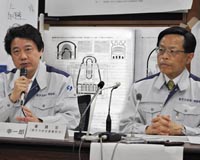 TEPCO lacked radiation meters after tsunami: agency
Tokyo (AFP) April 1, 2011 Japan's nuclear safety agency on Friday said it warned TEPCO for not having enough radiation meters for all workers battling to stabilise its Fukushima nuclear plant after devices were lost in a tsunami. Tokyo Electric Power Co. lost most of its dosimeters for workers at the Fukushima Daiichi plant when the tsunami from a 9.0 magnitude quake tore into the plant, the Nuclear and Industrial Sa ... read more |
|
|
| The content herein, unless otherwise known to be public domain, are Copyright 1995-2010 - SpaceDaily. AFP and UPI Wire Stories are copyright Agence France-Presse and United Press International. ESA Portal Reports are copyright European Space Agency. All NASA sourced material is public domain. Additional copyrights may apply in whole or part to other bona fide parties. Advertising does not imply endorsement,agreement or approval of any opinions, statements or information provided by SpaceDaily on any Web page published or hosted by SpaceDaily. Privacy Statement |


 del.icio.us
 Digg
Digg Reddit
 YahooMyWeb
 Google
 Facebook


