|
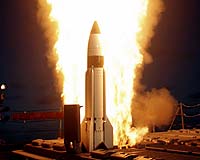
A Japanese warship failed to shoot down a dummy missile during the test off Hawaii on Wednesday using the US-developed Standard Missile 3 (SM-3), the defence ministry said in a statement.
Washington and Tokyo have been working jointly to install a shield against attacks from North Korea, which fired a missile over Japan's main island in 1998 and tested an atom bomb in 2006.
Officials said they were still investigating what went wrong in the test, which cost 6.2 billion yen (63 million dollars), excluding the missile, the value of which is secret.
"According to officials from the test site, the SM-3 missile was on track until only a few seconds before it was due to hit," a ministry official told reporters.
"Because of some problem it missed the target. We still don't know what happened in those few seconds," the official said.
An earlier test of the SM-3 interceptor by Japan in December high above the Pacific Ocean off Hawaii was successful.
Officials said the latest test from the Chokai destroyer was more challenging because the vessel was not notified in advance when the dummy missile would be launched.
They said that US forces had also conducted 15 similar tests, of which 12 were successful.
In September Japan successfully tested the new US-developed Patriot Advanced Capability 3 (PAC-3), a surface-to-air missile that tracks and hits incoming targets.
Japan plans to complete its missile shield by early 2011, deploying the PAC-3 missiles at 11 bases and setting up SM-3 missiles on several warships.
Despite its pacifist constitution and heavily reliance on the US military for protection, Japan has the world's fifth biggest military budget.
Share This Article With Planet Earth
 del.icio.us del.icio.us |
 Digg Digg |
 Reddit Reddit |
 YahooMyWeb YahooMyWeb |
 Google Google |
 Facebook Facebook |
 France Says Countries Should Be Free To Decide On Missile Shield
 Washington (AFP) Nov 15, 2008
| The content herein, unless otherwise known to be public domain, are Copyright 1995-2007 - SpaceDaily.AFP and UPI Wire Stories are copyright Agence France-Presse and United Press International. ESA Portal Reports are copyright European Space Agency. All NASA sourced material is public domain. Additional copyrights may apply in whole or part to other bona fide parties. Advertising does not imply endorsement,agreement or approval of any opinions, statements or information provided by SpaceDaily on any Web page published or hosted by SpaceDaily. Privacy Statement |