
 |
 |
 |
 |
 |
 |
 |
 |
 |
 |

| . |  |
. |

Tokyo (AFP) July 5, 2010 Japan's space agency said Monday it has found "minute particles" of what it hopes is asteroid dust in the capsule of the space probe Hayabusa which returned to Earth last month. Scientists hope any dust samples from the potato-shaped asteroid Itokawa could help reveal secrets about the origins of the solar system. "We have started the opening process of the sample container of Hayabusa since June 24, 2010 and confirmed there are minute particles," the Japan Aerospace Exploration Agency (JAXA) said. But the agency added it remained unclear whether the particles are contaminants from Earth or come from Itokawa, which the space probe landed on during its multi-billion-kilometre (mile) journey. It is expected to take months to get the final results of the analysis. Hayabusa project manager Junichiro Kawaguchi said scientists believed materials from Earth were among the particles found in the pod. "But it's important that it wasn't empty... I'm glad that there is the possibility" that some are from the asteroid, Kawaguchi told a press briefing. Researchers have not fully opened the capsule yet but have found more than 10 specks visible to the naked eye, said another JAXA scientist, Toshifumi Mukai. Mukai conceded these particles may not have come from the asteroid. "I have a feeling that they are not cosmic dust," he said, adding that it was also possible that they were from deep space. Separately, an electron microscope found two more minute particles, estimated to be slightly bigger than 10 microns each, scientists said. One micron is one-millionth of a metre. When Hayabusa was launched in 2003, the canister was open, meaning it may contain materials that originated on Earth, a JAXA spokesman said. Technical problems plagued the journey of Hayabusa, which at one stage spun out of control and lost contact with JAXA for seven weeks, delaying the mission for three years until the asteroid and Earth re-aligned. When it finally latched onto the Itokawa asteroid, a pellet-firing system designed to stir up dust malfunctioned, leaving it unclear how much material the probe was able to gather. After a seven-year space odyssey, the heatproof pod was fired back to Earth by the Hayabusa probe in June. Researchers at JAXA's Sagamihara Campus near Tokyo, have been opening the multi-layered canister in cooperation with US space agency NASA.
Share This Article With Planet Earth
Related Links Asteroid and Comet Mission News, Science and Technology

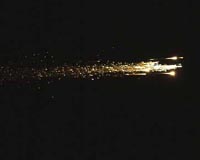 Students Record Spellbinding Video Of Disintegrating Spacecraft
Huntsville AL (SPX) Jun 29, 2010 Last year, high school science teacher Ron Dantowitz of Brookline, Mass., played a clever trick on three of his best students. He asked them to plan a hypothetical mission to fly onboard a NASA DC-8 aircraft and observe a spacecraft disintegrate as it came screaming into Earth's atmosphere. How would they record the event? What could they learn? For 6 months, they worked hard on their assi ... read more |
|
|
| The content herein, unless otherwise known to be public domain, are Copyright 1995-2010 - SpaceDaily. AFP and UPI Wire Stories are copyright Agence France-Presse and United Press International. ESA Portal Reports are copyright European Space Agency. All NASA sourced material is public domain. Additional copyrights may apply in whole or part to other bona fide parties. Advertising does not imply endorsement,agreement or approval of any opinions, statements or information provided by SpaceDaily on any Web page published or hosted by SpaceDaily. Privacy Statement |


 del.icio.us
 Digg
Digg Reddit
 YahooMyWeb
 Google
 Facebook


