
 |
 |
 |
 |
 |
 |
 |
 |
 |
 |

| . |  |
. |
Japanese physicists aim to unlock universe's mysteries
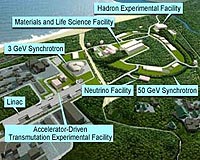
Tokai, Japan (AFP) Aug 27, 2008 As the world's scientists try to unzip mysteries about the universe, Japan is set to open its largest atomic science park to study the world at its smallest level. The Japan Proton Accelerator Research Complex (J-PARC Center) -- a 150 billion yen (1.36 billion dollar) project almost entirely funded by the government -- will open in December as one of the world's three hubs of atomic science. The gigantic complex in the nuclear research hub in Tokai, 100 kilometres (60 miles) northeast of Tokyo, is designed to help researchers study any object on Earth beneath the level of the atom. By better understanding the world in such minute detail, researchers hope to bring benefits to a variety of fields including pharmaceuticals, food processing and ion batteries. "As far as research results are made public, researchers can use these facilities for free," said Shoji Nagamiya, director of J-PARC Center. As many as 57 companies, largely in pharmaceuticals as well as universities and other institutes, are considering research at the science park, where up to 23 studies can take place simultaneously. "Researchers will be able to study some lighter atoms that X-rays cannot analyse, most notably those of water," said Kunihiro Suzuki, chief spokesman at the J-PARC Center. "This means they could unzip the mechanism of any living organism -- whose main part consists of water -- and this will hopefully lead to further development of, for example, cosmetics and frozen food products," he said. The research could also help in developing more advanced lithium ion batteries, Suzuki said. Such rechargeable batteries are widely used in electronics, but automakers are hoping to eventually use them to power eco-friendly cars. The plant will also conduct experiments to track down neutrinos -- the elusive and miniscule elementary particles discharged in nuclear reactions. Neutrinos are considered key to understanding the universe. The Sun and supernovas, or star explosions, send into the universe a mass of neutrinos, which do not appear to interact with mass and lack an electrical charge. Trillions of neutrinos pass through every person's body each day without changing course, but scientists are not clear what their function is. Tracking them down is no easy task. European physicists made history last year when they managed to take a snapshot of the very instant that a neutrino slammed into a laboratory detector. In a project to start in April next year, about 400 scientists at the J-PARC Center will send trillions of neutrinos on a 295-kilometre (183-mile) trip through the Earth's crust to another lab in western Japan. Invisible to the naked eye, each neutrino will make the entire journey in a mere 1,000th of one second. Scientists only hope to be able to detect 10 or 20 neutrinos a day from the J-PARC Center. But the experiment is still seen as significant as it could help explain one of the universe's biggest mysteries -- its infinite nature. The neutrinos are being sent to a lab called Super Kamiokande, which was constructed by 2002 Nobel Prize physicist Masatoshi Koshiba. Koshiba and his team have detected neutrinos set off by a supernova in an effort to understand the birth of the universe. The world's two other hubs for atom physics are in the United States, which has government-run laboratories in Illinois and Tennessee, and Western Europe, with laboratories in Britain, Germany and on the French-Swiss border. Community Email This Article Comment On This Article Share This Article With Planet Earth
Related Links Understanding Time and Space
 NASA Goddard Mission Approved To Probe Matter In Extreme Environments
 Greenbelt MD (SPX) Jun 30, 2008
An instrument to study the extreme environments of the universe has been given the "green light" from NASA Headquarters. The High-Resolution Soft X-Ray Spectrometer (SXS) was one of the two science proposals recently selected by NASA for the Explorer Program Mission of Opportunity investigations, and is managed at NASA's Goddard Space Flight Center in Greenbelt, Md. |
|
|

| The content herein, unless otherwise known to be public domain, are Copyright 1995-2007 - SpaceDaily.AFP and UPI Wire Stories are copyright Agence France-Presse and United Press International. ESA Portal Reports are copyright European Space Agency. All NASA sourced material is public domain. Additional copyrights may apply in whole or part to other bona fide parties. Advertising does not imply endorsement,agreement or approval of any opinions, statements or information provided by SpaceDaily on any Web page published or hosted by SpaceDaily. Privacy Statement |
 del.icio.us
 Digg
Digg Reddit
 YahooMyWeb
 Google
 Facebook