
 |
 |
 |
 |
 |
 |
 |
 |
 |
 |

| . |  |
. |

Tsukuba (AFP) Dec 12, 2010 Japan's Cyberdyne may share its name with the company responsible for nuclear destruction and the killer robots of the "Terminator" movie series, but the similarities end there. And if the idea of a robot suit helping those with disabilities walk sounds like the stuff of science fiction, think again: the real-life Cyberdyne is in the business of revolutionising lives. The firm produces an exoskeleton robot device called the Hybrid Assistive Limb, or HAL, which in another sci-fi related coincidence shares its name with the devious computer in Stanley Kubrick's "2001: A Space Odyssey". It gives power to its wearer by anticipating and supporting the user's body movements using sensors monitoring electric signals sent from the brain to the muscles. Current options are for a single leg device or both legs. HAL has many potential applications, from assisting caregivers lift people to helping construction workers or even firefighters. In one case, three weeks of training with HAL enabled a man who had suffered brain injuries to stand on his own feet after nine years in a wheelchair, said Cyberdyne CEO Yoshiyuki Sankai, professor at the University of Tsukuba. The group is now gearing up for mass-production and started leasing the battery-powered suit to welfare facilities last year. "Developing robots without utilising them in society would just be an extension of a hobby," Sankai, 52, said. "What I develop should be part of society and benefit people." A Japanese adventurer with disabilities is planning to leave his wheelchair behind and walk up a medieval French World Heritage site next year with the lower-limb HAL. Seiji Uchida, 48, who lost the ability to walk in a car accident 27 years ago, said earlier this year he has long dreamed of visiting the picturesque abbey of Mont Saint-Michel, set on a rocky islet in Normandy. Uchida said his visit to the island where a steep and narrow trail leads to an abbey and former fortress was to "prove that it is possible for people with disabilities to visit the world's historic sites without relying on facilities like elevators". Some 50 hospitals and homes for the elderly in Japan are using a lower-limb version of HAL to assist disabled people. Rental fees for both legs are 140,000-150,000 yen a month (1,600-1,800 dollars). Cyberdyne plans to start leasing a full-body version for caregivers next year, which assists both arms and legs and allows users to carry a load of up to 70 kilogrammes (154 pounds) with one arm. It aims to begin sales to consumers from 2015. More than 60 people have signed up as regular visitors to Cyberdyne Studio, a walking-training version of the usual fitness clubs that opened in September in Tsukuba City northeast of Tokyo, using the lower-limb model. Sankai's practicality-first approach is unique in a country where many researchers focus on high concept robotics with eye-catching, headline-grabbing humanoids and other machines that have little useful application in reality. The professor is critical of research that has no use outside the laboratory. "Many in the research and development field are motivated by their own interest. They produce a thing and then think, 'What could this be used for?'" "Research isn't for just writing papers," he said. Sankai has retained his enthusiasm since his days as a self-styled child scientist who practised melting aluminum in the backyard and built walkie-talkies from scratch. He said he had wanted to develop robots since he was a child and remembers "odd experiments" he did such as giving a frog's leg an electric stimulus using a home-made radio-wave transmitter. Sankai is now in talks with foreign companies such as France's Bouygue construction group. "We are exploring cooperation outside the medical and welfare field, for ways to help heavy physical work," he said. Bayer MaterialScience in the German conglomerate Bayer announced in October it would help Cyberdyne replace metal parts with high-quality plastics to pave the way for easier and cheaper production of the complex shaped suit. HAL will also be tried out in hospitals in Denmark and Sweden. Sankai plans to invite foreign students on training programmes at Tsukuba, educate them on using HAL and send them home with joint research contracts. HAL could also be used by rescue workers, said Sankai. "People from the fire and disaster management agency came to me and told me about rescuers who lost their lives while on duty," making him think an appropriate machine could save lives. "I want to think about what our technology can contribute," Sankai said.
Share This Article With Planet Earth
Related Links All about the robots on Earth and beyond!

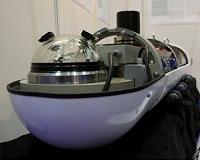 Underwater Robots On Course To The Deep Sea
Munich, Germany (SPX) Nov 26, 2010 Robots do not have to breathe. For this reason they can dive longer than any human. Equipped with the necessary sensor technology they inspect docks or venture down to the ocean fl oor to search for raw materials. At present, researchers are developing a model which will carry out routine tasks independently, without help from humans. Even when equipped with compressed-air bottles and divi ... read more |
|
|
| The content herein, unless otherwise known to be public domain, are Copyright 1995-2010 - SpaceDaily. AFP and UPI Wire Stories are copyright Agence France-Presse and United Press International. ESA Portal Reports are copyright European Space Agency. All NASA sourced material is public domain. Additional copyrights may apply in whole or part to other bona fide parties. Advertising does not imply endorsement,agreement or approval of any opinions, statements or information provided by SpaceDaily on any Web page published or hosted by SpaceDaily. Privacy Statement |


 del.icio.us
 Digg
Digg Reddit
 YahooMyWeb
 Google
 Facebook


