
 |
 |
 |
 |
 |
 |
 |
 |
 |
 |

| . |  |
. |

London, UK (SPX) Apr 19, 2011 Galaxies are thought to develop by the gravitational attraction between and merger of smaller 'sub-galaxies', a process that standard cosmological ideas suggest should be ongoing. But new data from a team of scientists from Liverpool John Moores University directly challenges this idea, suggesting that the growth of some of the most massive objects stopped 7 billion years ago when the Universe was half its present age. On Monday 18 April team member Claire Burke will present their work at the Royal Astronomical Society's National Astronomy Meeting (NAM 2011) in Llandudno, Wales. How galaxies form and then evolve is still a major unanswered question in astronomy. The sub-galaxy units thought to have merged to make galaxies, are themselves associated with fluctuations in the density of material in the cosmos left over from the Big Bang and seen today as temperature 'ripples' in the cosmic background radiation. To study galaxy evolution, the team, which also included Professor Chris Collins and Dr John Stott (now at the University of Durham) looked at the most massive galaxies in the Universe, known as Brightest Cluster Galaxies (BCGs) and so called because of their location at the centre of galaxy clusters, structures that typically contain hundreds of galaxies. In the nearby Universe BCGs are elliptical in shape and are the largest, most uniform and most massive class of galaxies observed, with each galaxy having a mass equivalent to up to 100 trillion (100 million million) Suns. Like smaller elliptical galaxies, BCGs are composed of old red stars and are thought to have formed through mergers of the dense population of sub-galaxies that were found in the centre of galaxy clusters. By studying how BCGs grow in size gives an insight into the formation and evolution of galaxies in general. Measuring the sizes of BCGs has always been difficult as their outer regions are very faint. Burke and her team have overcome this by using long exposure images from the Hubble Space Telescope data archive that pick up the dimmer parts of these galaxies. The BCGs they studied are so distant that the light we detect from them left 7 billion years ago, so they appear as they were when the Universe was less than half its present age. When they examined the Hubble images, the team found that these distant BCGs are almost the same size as their nearby counterparts and that these galaxies can have grown by at most 30% in the last 9 billion years. This is in line with other work by the same research group, but is quite unlike the observed development of 'regular' elliptical galaxies. More significantly, conventional simulations of the evolution of the Universe predict that BCGs should have at least tripled in size over that time. Ms Burke comments: "The lack of growth of the most massive galaxies is a major challenge to current models of the formation and evolution of large scale structure in the Universe. Our work suggests that cosmologists appear to lack some of the crucial ingredients they need to understand how galaxies evolved from the distant past to the present day."
Share This Article With Planet Earth
Related Links Royal Astronomical Society Stellar Chemistry, The Universe And All Within It

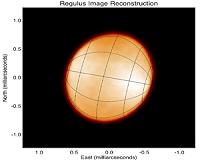 Zoom-Up Star Photos Poke Holes In Century-Old Astronomical Theory
Ann Arbor MI (SPX) Apr 19, 2011 The hottest stars in the universe spin so fast that they get a bit squished at their poles and dimmer around their middle. The 90-year-old theory that predicts the extent of this "gravity darkening" phenomenon has major flaws, according to a new study led by University of Michigan astronomers. The von Zeipel law, named for its creator, Swedish astronomer Edvard Hugo von Zeipel, has been us ... read more |
|
|
| The content herein, unless otherwise known to be public domain, are Copyright 1995-2010 - SpaceDaily. AFP and UPI Wire Stories are copyright Agence France-Presse and United Press International. ESA Portal Reports are copyright European Space Agency. All NASA sourced material is public domain. Additional copyrights may apply in whole or part to other bona fide parties. Advertising does not imply endorsement,agreement or approval of any opinions, statements or information provided by SpaceDaily on any Web page published or hosted by SpaceDaily. Privacy Statement |


 del.icio.us
 Digg
Digg Reddit
 YahooMyWeb
 Google
 Facebook


